more reposted old stuff at theAbysmal
Longer Periods of time tend to be organized by orders of 10. There are more compelling measures to consider.
Like 52 years and 260 years and 5,200 years.
more reposted old stuff at theAbysmal
Longer Periods of time tend to be organized by orders of 10. There are more compelling measures to consider.
Like 52 years and 260 years and 5,200 years.
Geometric Time in 1- and 2-Dimensions
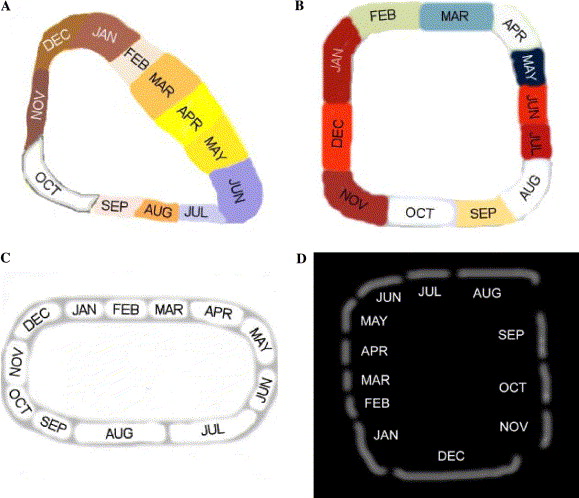
Figurate numbers are a mathematical way to represent various geometric shapes: triangle, square, pentagon in 2-dimensions; tetrahedron, cube, icosahedron in 3-dimensions; pentatope, and hypercubes in 4-dimensions; 2-d and 3-d fractals in their own pseudo-dimension. For the moment, let’s take a look at 0-, 1-, and 2-d representations of the months (15 to 60 days).
For the mostpart, theAbysmal Calendar represents the months of its various years as rectangles. The 13-month calendar’s months are composed of 4 weeks of 7 days, which creates a 4 x 7 rectangle. Beyond these, there are many other variations possible, and while they are aesthetic, there are some practical functions as well.
Continue reading Figurate Calendars Ia Gallery of Calendar images from 4-day weeks up to 91-day quarters.

theAbysmal Calendar in Anishinàbemowin or Omàmiwininìmowin
Mind you, I’m not entirely sure that “Nikìwagad Padakishkwemagahigan” means “theAbysmal Calendar.” From the Algonquin Lexicon (from Kitigan-Zibi Education Sector). From what I gather is that I’ve translated to something like “growing darkness calendar.” Until I consult with a fluent speaker, I’ll have to use it as a placeholder until I find something more similar in meaning to “abysmal.”

While I’m decolonizing time by kicking the Gregorian Calendar out of the Global spotlight, it’s essential to acknowledge and respect the place where I am: unceded Anishinaabe territory, it felt appropriate to make this calendar more accessible to the People.
Nikìwagad Padakishkwemagahigan
I haven’t translated it to French, German, Spanish, or Japanese, languages into which I can confidently translate theAbysmal. The Native Peoples of North America take precedent. Fortunately, I won’t have to translate it into Nahuatl or any of the Maya languages (or Spanish for the matter). These cultures have a long history of using a more sophisticated calendar than theAbysmal.
There are words and thoughts about time I have not even dreamed of.
Did you know that time can be represented as a wave simply by adding colours to your calendar?
Me neither.
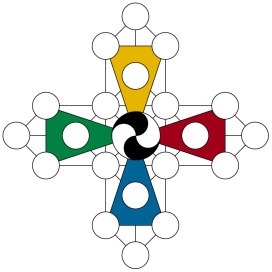
The colours in question are colours associated with the four cardinal directions. There are any number of cultural traditions with respect to which colour is associated with which direction, and so I decided to create something anew, rather than appropriate an existing set of colours.
I applied the four colours to the time-schematic illustration below:

Our common experience, across the globe, over time.
Time is such a nebulous concept, in no small part because so many of us have so much stake in all of the ways it takes form in our lives: schedules, anniversaries, history, evolution, prediction, etc. It is embedded in our languages, and is inseparable from our thoughts of space.
 Rethinking Time