the present shape of our pasts and futures
“History doesn’t repeat itself, but it rhymes.”
Mark Twain, probably

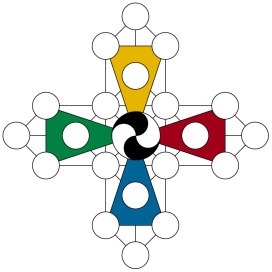
Above is a visualization of theAbysmal 13-month calendar. The number 13 is fundamentally important to the 13-month calendar (naturally), as well as the 260-+day calendar. The two systems generate a cycle of 52 years, which can be used as the basis for longer periods of time.
Instead of our base-10 system i.e. decades, centuries, millennia, myriad, etc., theAbysmal lends itself to 13s.
52 is the product of 13 and 4.
260 is the product of 13 and 20 as well as 52 and 5.
364 is the product of 13 and 28 as well as 52 and 7.
Mesoamerican Calendars follow cycles of 52 vague solar years (365 days without a leap day), the Long Count Calendars scale by orders of 20 tun (360 continuous days). theAbysmal Calendar follows cycles of 52 and 260 tropical years (365 days plus the leap day), although many other measures are possible.

Above is theAbysmal’s visualization of 260 years. Each year is assigned a colour representing the Cardinal Directions: green East, blue North, red West, yellow South. Each circle is one year, each rectangle a period of 20 years, tentatively called a generation.

In North America, cohorts have been labelled as generations of about 20 years as indicated in the graphic above. The current Era for theAbysmal Calendar began 2012, which appears to be the demarcation between Generation Z (Zoomers) and Generation Alpha.
There is another tradition that can be applied to theAbysmal models. When considering the long-term repercussions of major decisions, many Native Peoples think in terms of 7 generations. What decisions were made 7 generations ago? How will today’s decisions affect those 7 generations from now? While theAbysmal’s system is rigidly numeric, the idea of generations is social.
7 generations can be considered part of living memory for those in a healthy society: great-grandparents, grandparents, parents, oneself, children, grandchildren, great-grandchildren. The difference between these generations can vary wildly, as mothers can bear children from their teens up to their early 50s.
With theAbysmal model, the 7th generation of 20 years falls at the midpoint of the 260-year cycle. We might consider how our decisions today will affect our descendants in 130 years. How have decisions made 130 years ago affect us today? Using 2012 as our marker, that’s looking back to 1882.
1872 to 1892 was the midpoint of the previous 260-year Era. It coincides with the Gilded Age in the USA, and the peak of the British Victorian Era. More importantly, it’s also the period when Black People liberated from enslavement began to shape the culture of North America with greater agency through music, dance, language, and so on.
Consider how such contributions continue to influence Peoples of the World. Hip-hop music and culture have spread globally within a few short decades, having evolved from Delta Blues to Jazz to Rock’n’Roll to Electronic Dance Music and all manner of genres in between. What grand influence will we have on our descendants?

the Shape of History
As mentioned above, the Gregorian, and a great many other calendars, number the years in a linear fashion, typically counting from 1 to infinity. The Gregorian, serving as most of the world’s common calendar, shapes linear history by decades, centuries, millennia, etc.
theAbysmal has discovered a pattern of multiples of 260 years in Western History. Granted, there are arguments for other dates for these events, and not all events are equally important to all people. What’s particularly striking are how these periods relate to calendars and major cultural shifts.
45 BC – Caesar introduces the Julian Calendar
476 CE – fall of Western Roman Empire
= 520 Years (2 x 260)
476 CE – the Fall of the Western Roman Empire
1776 CE – the American Revolutionary War
= 1300 years (5 x 260)
712 CE – Ummayad conquest of Iberian Peninsula
1492 CE – Queen Isabella and King Ferdinand reclaim last Muslim city (la Reconquista)
= 780 years (3 x 260)
1492 CE – Columbus lands at North America
1752 CE – British Empire adopts the Gregorian Calendar
= 260 years
1752 CE – beginning of the Industrial Revolution, the Industrial Era
2012 CE – 13.0.0.0.0 the end of the Mesoamerican 13th baktun
= 260 years
Mind you, these dates are non-continuous, as there is a 24-year skew between some of them – 1752 vs 1776. This remains a mystery.
to Sum Up
How we view the past informs our decisions today, and with a longer, more meaningful view of history, we may be better able to anticipate our way through what promises to be a volatile, stormy future.
A new perspective, a new calendar, and new interrelationships.

 Rethinking Time