more reposted old stuff at theAbysmal
Longer Periods of time tend to be organized by orders of 10. There are more compelling measures to consider.
Like 52 years and 260 years and 5,200 years.
more reposted old stuff at theAbysmal
Longer Periods of time tend to be organized by orders of 10. There are more compelling measures to consider.
Like 52 years and 260 years and 5,200 years.
How we’ve trapped ourselves in time.
While browsing through the wikipedia entry on history, I was surprised that there was no mention of calendars. History, in one sense, is the fixing of past events, for which there is documented evidence in time – the founding of Rome 753 BC, for example. While oral histories are considered less reliable by western thinkers, some have proven themselves time and again.
Chronological history is often defined by the development of written records, but also on a calendrical framework. Unfortunately, the global calendar is currently the godawful Gregorian, which seizes history in a rigid linear chronological framework.
The problem isn’t the linear framework in and of itself, but rather the general absence of alternatives. Studying the history of Persia, for example, should rely more on the Zoroastrian and Islamic calendars, as Iran does not use the Gregorian. However, events in Persia/Iran are presented to Westerners with Gregorian dates, which distorts the shape of events.

Comparing the dates when Calendars began framing their respective histories.
source:
Reingold, Edward M and Nachum Dershowitz. Calendrical Calculations – the Ultimate Edition. Cambridge University Press. New York, 2018.
| Calendar | Epoch RD | Equivalents |
| Julian Day Number | -1721424.5 | Nov 24, -4713 (GC) Jan 1, 4713 BCE (JC) |
| Hebrew | -1373427 | Sep 7, -3760 (GC) Oct 7, 3761 BCE (JC) |
| Mayan | -1137142 | Aug 11, -3113 (GC) Sep 6, 3114 BCE (JC) |
| Hindu Kali Yuga | -1132959 | Jan 23, -3101 (GC) Feb 18, 3102 BCE (JC) |
| Chinese | -963099 | Feb 15, -2636 (GC) Mar 8, 2637 BCE (JC) |
| Samaritan | -598573 | Mar 3, -1638 (GC) Mar 15, 1639 BCE (JC) |
| Egyptian | -272787 | Feb 18, -746 (GC) Feb 26, 747 BCE (JC) |
| Babylonian | -113502 | Mar 29, -310 (GC) Apr 3, 311 BCE (JC) |
| Tibetan | -46410 | Dec 7, -127 (GC) Dec 10, 128 BCE (JC) |
| Julian | -1 | Dec 30, 0 (GC) Jan 1, 1 CE (JC) |
| Gregorian | 1 | Jan 1, 1 (GC) Jan 3, 1 CE (JC) |
| ISO | 1 | Jan 1, 1 (GC) Jan 3, 1 CE (JC) |
| Akan | 37 | Feb 6, 1 (GC) Feb 8, 1 CE (JC) |
| Ethiopic | 2796 | Aug 27, 8 (GC) Aug 29, 8 CE (JC) |
| Coptic | 103605 | Aug 29, 284 (GC) Aug 29, 284 CE (JC) |
| Armenian | 201443 | Jul 13, 552 (GC) Jul 11, 552 CE (JC) |
| Persian | 226896 | Mar 22, 622 (GC) Mar 19, 622 (JC) |
| Islamic | 227015 | Jul 19, 622 (GC) Jul 16, 622 CE (JC) |
| Zoroastrian | 230638 | Jun 19, 632 (GC) Jun 16, 632 CE (JC) |
| French Revolutionary | 654415 | Sep 22, 1792 (GC) Sep 11, 1792 CE (JC) |
| Bahá’í | 673222 | Mar 21, 1844 (GC) Mar9, 1844 CE (JC) |
| Modified Julian Day | 678576 | Nov 17, 1858 (GC) Nov 5, 1858 CE (JC) |
| Unix | 719163 | Jan 1, 1970 (GC) Dec 19, 1969 CE (JC) |
Experimenting with symbolism and cardinal directions.
theAbysmal Calendar divides the year into 365 days, as well as 364+1 and 360+5 days. On top of that, it follows all sorts of measures beyond the 7-day week. Most recently, I’ve been sorting out a series of 20 glyphs to function much as they do in the Mesoamerican calendar system, however, I’ve changed some of them to better suit the ecological characters of the Eastern Woodlands. For example, I replaced Monkey with Raccoon, but they both serve as trickster types. I replaced Jaguar with Bear, as they are both powerful animals associated with magic.
What I discovered in all of this was that the Year named after Rabbit occurs during the Leap Year. This wasn’t intentional (not deliberate anyway), but so delightful to trip over.
So this upcoming year (New Year is December 21st 2019) is the year 8~Rabbit. Make of it what you will.
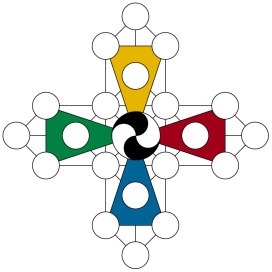
The colours for the cardinal directions are represented below:

As applied to the calendar, these colours reveal patterns within structure. Enjoy for what they’re worth.
Year 7, 8~Rabbit, by 7-day Weeks and Months (364+1)
Year 7, 8~Rabbit, by 13-day Weeks and Houses (364+1)
Year 7, 8~Rabbit, by 9-day Weeks and Hora (360+5)
Year 7, 8~Rabbit, by 5-day Weeks and Hora (360+5)
What do you think?
*Please don’t berate me for my lack of design skills. I can barely identify greyscale. LOL
“History doesn’t repeat itself, but it rhymes.”
Mark Twain, maybe

taoism, Hinduism, the belief systems of the Huichol, Maya, Mexica have all influenced the development of theAbysmal calendar, and what they have in common is a view of consciousness as the central element of life: we are the centre of the universe, each of us, simply by virtue of our sensory-perceptive apparatus.
Here’s an example: you can never walk to the horizon.
Continue reading Shape of History Past and Future Rethinking Time