Moon 105 of Era 2 or Moon 6,537 of the Epoch.
A number of adjustments to theAbysmal Calendar this past year.

theAbysmal Lunar Month begins at the New Moon according to EST (my local time zone, UCT – 5), so these dates might be off by a day depending on where in the World you live.
Changes to theAbysmal Calendar
Some updates from the past year and earlier.
Epoch, Era
see: theAbysmal Lunar Calendars
The Epoch refers to the starting date of a calendar. In this case, I’ve chosen the year 1492 CE as the beginning of settler-colonial history in the Americas. Eras begin at the New Moon prior to Northern Solstice. Eras are 260 years long.
- theAbysmal Epoch & Era 0 began May 26 1492 (Julian) or Jun 4 (Gregorian)
- Era 1 began May 31 1752 (Julian) or Jun 11 (Gregorian)
- Era 2 began Jun 19 2012 (Gregorian)
New Year Day, Leap Day, Era Day
see: theAbysmal Calendar & Exceptional Days
Previously, New Year Day fell on Dec 21 and Leap Day on Dec 20. While Dec 21 remains the principal New Year Day, it isn’t the only one, and the Leap Day was moved.
- New Year for odd-numbered calendars on Jun 22
- New Year for even-numbered calendars on Dec 22
- Leap Day moved from Dec 20 to Jun 21 (in a year with Feb 29)
- Era Day replaces the final Leap Day of an Era (Jun 21 2012)
Odd-numbered calendars divide the year into 365, 363, and 361 days. Even-numbered divide the year into 364, 362, and 360 days.
260-Day Calendar
See: 260-day calendar.

Glyph names changed since originally developed:
- X from dog to Coyote
- XII from maize to Mushroom
- XIII from reed to Tobacco
- XVII from earth to Earthquake
- XX from sunflower to Sun
256-Day Calendar
see: 256-day calendar
This calendar is built on the foundation of the Cardinal Directions, and has spawned a four-fold calendar system that lends itself to scaling up and down measures of time from seconds to aeons.

I Ching provides a structure by which to organize the fourfold calendar.

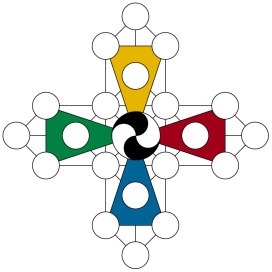
At centre, the four directions: blue North, green East, yellow South, red West. The circles are made out of two-line, three-line, and four-line figures, or 16 bigrams, 64 trigrams, and 256 quadrigrams.
 Rethinking Time