It’s Northern Winter and Southern Summer. How do you figure a global calendar?
The question of the different ways we experience the year has been an interesting challenge, but fortunately, the Sun and Earth provide us with a complementary reflection.

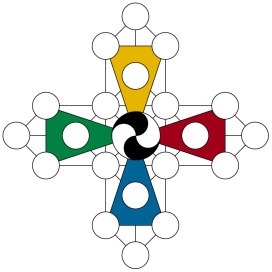
Above we have the 13 months of the Year for the Northern Hemisphere. The Year begins at the bottom at the Winter Solstice (dec 21), and progresses clockwise through the year.

Above, the equivalent calendar for the Southern Hemisphere. The dark days of Winter stay at bottom, so the Year begins at the Southern Solstice at top, and progresses counter-clockwise aka widdershins, throughout the year.
In the North, if we face the path of the Sun, then we face South. The Sun rises in the East (to the left) and sets in the West (to the right) describing a clockwise direction.
In the South, if we face the path of the Sun, then we face North. The Sun rises in the East (to the right) and sets in the West (to the left) describing a counterclockwise direction.
I imagine a global game of catch, where at the Summer Solstice, we pass the sun back over the Equator, where our counterparts pass it back at the Winter Solstice.
The point being, I don’t understand Christmas, or any Winter Celebrations, that take place at the height of Summer (Australia, New Zealand, I’m looking at you).
But local customs aren’t for me to understand, just to enjoy or avoid, depending on the details.
Have a happy year, regardless of when it begins, how long it lasts, and how you dance it.

 Rethinking Time