When you sing is as important as what you sing.
I’ve been exploring the ties between musical time, calendar time, and natural time for a while, and there’s a underlying current that leads me to reconsider our relationship to our holidays.
In terms of the diversity of celebrations, observations, and remembrances, I’ve limited theAbysmal Calendar to one type of holiday, New Years. theAbysmal Calendar’s holidays suggest themselves according to natural time, i.e. New & Full Moons, Solstices, Equinoxes, which lends itself to rituals involving light in darkness, like Diwali, Hanukkah, Winter Solstice, Christmas, Kwanzaa, etc.
There’s a longer standing relationship between the Winter Solstice, Christmas, the carol the 12 days of Christmas, and the New Year that inspired me to take a more considered look at the New Year holiday.
In order to rethink music, time, seasons, I refer back to this particular description of musical affect by La Monte Young from the World According to John Coltrane
“One of the really important things about modal music is that you have a set of frequency relationships that are repeated over and over, and because of the emphasis on intonation in Indian Classical music this set of frequency relationships is very much in exactly the same place so that each frequency comes right back at the same place. This sets up a series of patterns in the mechanism of the nervous system of the listener so that a psychological state is created. If you believe that the Universe is composed of vibrations then you can understand how a study of sound– which is the most concrete form of vibrations that the human mechanism can immediately assimilate–can be an introduction to the understanding of universal structure.“
Christmastime and the Carol
So Long, and Thanks for All the Gifts
There’s a little bit of mathemagic in the carol the 12 Days of Christmas, but it’s mostly addition. Before we get to the song itself, let’s take a brief look at the secular Christian holiday season:
Dec 21 – Southern Solstice
Dec 24 – Christmas Eve
Dec 25 – Christmas Day
Jan 1 – New Year Day
Dec 25 to Jan 5 – 12 Days of Christmas
The Sun reaches its lowest point in the Northern sky on the Solstice where it remains for three days until it begins to climb its way upward until the Summer Solstice. Dying and rising again, as it were.
The 12 days of Christmas span the New Year, and were used to plan for the year ahead. On the first day of Christmas, you planned for January, the 1st month. 2nd day plan for February and so on. In terms of New Year’s resolutions, this strikes me as a far more pragmatic means of achieving goals, as opposed to our more common public declaration and hoping for the best. One thing I appreciate about the 12 days are how they begin in the old year and continue into the new. I’ll come back to this a little further along.
the Carol
For those unfamiliar with the carol the 12 Days of Christmas, I salute you. It’s a cumulative song in which the person singing refers to the gifts they receive from their true love on each of the 12 days.
On the first day of Christmas, my true love gave to me
A partridge in a pear tree.
On the second day of Christmas, my true love gave to me
Two turtle doves, and a partridge in a pear tree.
On the third day of Christmas, my true love gave to me
Three French hens, two turtle doves, and a partridge in a pear tree.
And so on with the following procession of gifts (although there are variations):
- partridge in a pear tree
- turtle doves
- French hens
- calling birds
- golden rings
- geese a-laying
- swans a-swimming
- maids a-milking
- ladies dancing
- lords a-leaping
- pipers piping
- drummers drumming
That’s generous, if impractical. There’s a connection here between the 12 gifts and using the 12 days to plan the year ahead. But first, let’s take a closer look at this pile of Christmas gifts, specifically, how many is that?
First, if we count “a partridge in a pear tree” as one gift, rather than two, and discount the cows with the “maid a-milking” so we can follow a regular numeric progression, we get this:
1 +
2 + 1 +
3 + 2 + 1 +
4 + 3 + 2 + 1 +
5 + 4 + 3 + 2 + 1 +
6 + 5 + 4 + 3 + 2 + 1 +
7 + 6 + 5 + 4 + 3 + 2 + 1 +
8 + 7 + 6 + 5 + 4 + 3 + 2 + 1 +
9 + 8 + 7 + 6 + 5 + 4 + 3 + 2 + 1 +
10 + 9 + 8 + 7 + 6 + 5 + 4 + 3 + 2 + 1 +
11 + 10 + 9 + 8 + 7 + 6 + 5 + 4 + 3 + 2 + 1 +
12 + 11 + 10 + 9 + 8 + 7 + 6 + 5 + 4 + 3 + 2 + 1
=
364
Depending on how that displays on your device, it should resemble a Christmas tree. The other thing to note is the total number of gifts is one day shy of 365, the days of the year.
Second, if we plan our year during the 12 Days of Christmas using the structure of the carol, the ritual becomes a bit different. Instead of planning for one month each day, we plan a new month and revise the ones we’ve already planned for.
1st Day: plan Jan
2nd Day: plan Feb, revise Jan
3rd Day: Mar, Feb, Jan
4th Day: Apr, Mar, Feb, Jan
5th Day: May, Apr, Mar, Feb, Jan
6th Day: Jun, May, Apr, Mar, Feb, Jan
7th Day: Jul, Jun, May, Apr, Mar, Feb, Jan
8th Day: Aug, Jul, Jun, May, Apr, Mar, Feb, Jan
9th Day: Sep, Aug, Jul, Jun, May, Apr, Mar, Feb, Jan
10th Day: Oct, Sep, Aug, Jul, Jun, May, Apr, Mar, Feb, Jan
11th Day: Nov, Oct, Sep, Aug, Jul, Jun, May, Apr, Mar, Feb, Jan
12th Day: Dec, Nov, Oct, Sep, Aug, Jul, Jun, May, Apr, Mar, Feb, Jan
How can we best make our plans flexible and adaptable, given how unpredictable the climatic and political environments at the moment?
theAbysmal New Year
theAbysmal Calendar can accommodate a similar ritual using the 13 days at the New Year. This encompasses the last six days of the old year (Dec 15-20), the New Year (Dec 21) and the first six days of the new year (Dec 22-27).
Unlike 12 days, with 13 there is a clear midpoint. If we number the Days of the New Year the same way we number the months, 0 to 12, then Day 6 and Month 6 fall midway. Day 6 (Dec 21) falls on the Southern Solstice, Month 6 contains the Northern Solstice. On the shortest day Winter, we plan for the month at the height of Summer.
Of course, the Seasons are reversed in the Southern Hemisphere.

clockwise from bottom

counterclockwise from top
theAbysmal Days of the New Year
Below is a correlation between the 13 Days of the New Year for Year 7 (Dec 21 2019 to Dec 20 2020) and the 13 Months. All but the first 10 days of Year 7 occur during 2020.

Although these are directly correlated, I think the repetition of the months in the manner of the Christmas carol is a more thorough consideration of the year to come.
Below is a one-page summary of the 13-month year. If one is going to plan ahead, it’s important to note important dates – including New and Full Moons, Solstices, Equinoxes, and meaningful holidays, remembrances, observances, and festivals.

While theAbysmal is a numeric calendar, it does lend itself to certain holidays based on how it is structured. These are exceptional days, like the New Year Day and Leap Day.
theAbysmal Holidays
The when of our celebrations inform the why, what, and how. While Christmas retains rituals from Nordic Europe’s Solstice festivals, it retains many of these trappings in the Southern Hemisphere, where it takes place at high Summer. How would Australia, New Zealand, South Africa, Argentina celebrating Christmas on Jun 25 change things for everyone?
When to Holiday?
Scheduling holidays are markers for the Seasons and the Moon is as old as the hills. These events are global, and the rhythm is older than life on Earth. We are biologically, evolutionarily tied to the rhythms of nature, and celebrating these events together goes a long way to improving our public health.
Around dusk & dawn, our body’s circadian rhythm synchronizes itself to the day. Around the Equinoxes, our body synchronizes itself to the year. The phases of the Moon are the other principal rhythm by which our bodies synchronize themselves.
Observing the Solstice, Equinoxes, New and Full Moons are considered a basic aspect of human behaviour. That’s 29-30 holidays right there.
Modern pagans use a Wheel of the Year that marks the Solstices, Equinoxes and their midpoints. theAbysmal Calendar has a version, although the quarters fall within a day or two of the Equinoxes.
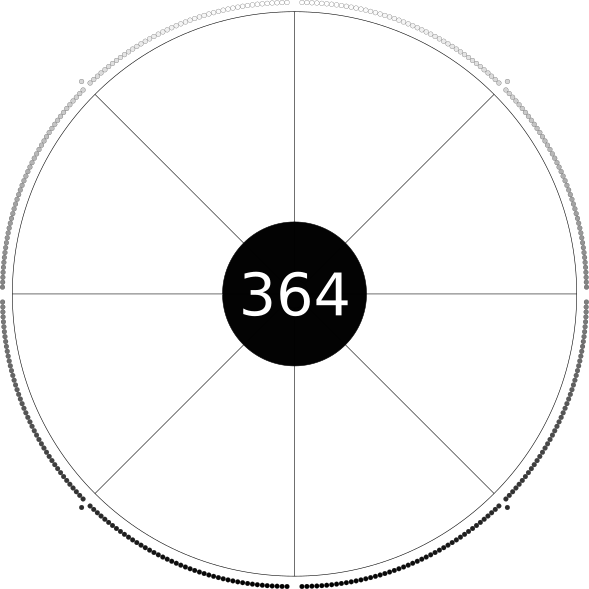
Beginning at the top, at Summer Solstice, if we look for the midpoint of 365 days, we get Dec 21 – the New Year Day – and four quarters of 91 days. If we consider the first & last day of each quarter, as well as the midquarter days, then the year looks like this:
Dec 20-22
Feb 5
Mar 22-23 (21-22)
May 7 (6)
Jun 21-22 (20-22)
Aug 6
Sep 20-21
Nov 5
Dates in parenthesis are for a Leap Year.
Dec dates include New Year Day – Dec 21
Jun dates include Leap Year Day – (Jun 21)
The above dates provide us with 13 annual holidays, plus Leap Day.
Holidays could be further determined by using the Binary Year model.

The image above represents the 365 days of the year. The lines represent the linear progression of time. The placement of the days in the circle has to do with their central place in odd divisions.
Beginning at Summer Solstice (the top of the image above), Jun 22 in the Northern Hemisphere, the midyear day falls on Dec 21. That is the central black circle, representing the Winter Solstice. The remaining 364 days can be divided into four quarters of 91 days. The midquarter days fall on Aug 6, Nov 5, Feb 5, May 7. These are the four days. This leaves us with eight divisions of 45 days, the midpoint of which gives us the 8 days. Then 32 measures of 11, 64 measures of 5, and 128 pairs remain.
Dec 21
Aug 6 Nov 5 Feb 5 May 7
Jul 14 Aug 29 Oct 13 Nov 28 Jan 13 Feb 28 Apr 13 May 29
These present 13 regularly occurring holidays. The first five are the same as with the Wheel of the Year, whereas the other 8 differ. Taken together, these cover a total of 21 holidays.
There are plenty of other ways to mark the year. Let’s move on to the details.
How to Holiday?
The particulars are up to each individual, family, community to determine for themselves. Much depends on a thriving mythsystem from which stories associated with the year relate each of us back to one another, and the greater mysteries from which we are inseparable.
Returning to our theme of music and the holidays, here’s La Monte Young commenting on music.
“One of the really important things about modal music is that you have a set of frequency relationships that are repeated over and over, and because of the emphasis on intonation in Indian Classical music this set of frequency relationships is very much in exactly the same place so that each frequency comes right back at the same place. This sets up a series of patterns in the mechanism of the nervous system of the listener so that a psychological state is created. If you believe that the Universe is composed of vibrations then you can understand how a study of sound– which is the most concrete form of vibrations that the human mechanism can immediately assimilate–can be an introduction to the understanding of universal structure.”
AUM or OM is a sacred sound in South Asia. It is the sound made when the Universe came into being. To sound it properly, it evokes all the open vowel sounds. Language is considered a flow of this sound interrupted by consonants.

Imagine that this great sound, AUM, is continuous and persistent, such that musicians evoke it through their art, dancers evoke it through their motion.
If there is to be a music of the year, how would we represent it?
Frequency
We describe notes in terms of frequency (cycles per second, or Hz), we set the tempo according to frequency (beats per minute), we schedule practice by frequency (thrice a week), as well as performance (eight times a year).
In terms of energy, the lower notes require less, higher notes require more. Slower tempos require less, faster require more. Single performances have greater stakes, multiple have lesser.
Winter receives less sunlight, the Summer receives more. Spring the rate of increase in daylight accelerates. In Autumn, the rate of decrease accelerates.
Winter – slow tempo, low pitch
Spring – increasing & decreasing tempo, rising pitch
Summer – slow tempo, high pitch
Autumn – increasing & decreasing tempo, falling pitch
The same can be applied to the Lunar and Daily rounds.
How to apply this to musical composition remains open for exploration. Here’s a start.
 Rethinking Time