Figurate Calendars I

Geometric Time in 1- and 2-Dimensions

Figurate numbers are a mathematical way to represent various geometric shapes: triangle, square, pentagon in 2-dimensions; tetrahedron, cube, icosahedron in 3-dimensions; pentatope, and hypercubes in 4-dimensions; 2-d and 3-d fractals in their own pseudo-dimension. For the moment, let’s take a look at 0-, 1-, and 2-d representations of the months (15 to 60 days).

For the mostpart, theAbysmal Calendar represents the months of its various years as rectangles. The 13-month calendar’s months are composed of 4 weeks of 7 days, which creates a 4 x 7 rectangle. Beyond these, there are many other variations possible, and while they are aesthetic, there are some practical functions as well.

Continue reading Figurate Calendars I

the Prismatic New Year

Colour your days

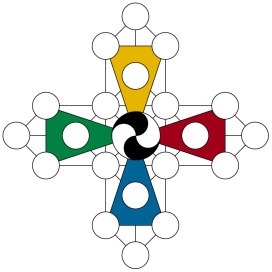
The Prismatic Calendar is the name assigned to the 365 days of the year, each assigned a different colour. Near enough – 360 colours for the entire year. The colours were determined by taking the four colours assigned to the cardinal directions and interpolating them.

a circle divided into four by an X. At bottom and moving clockwise, the colour of each quarter is Blue, Green, Yellow, and Red.
theAbysmal Wheel

Expanding these four colours to the full visible spectrum puts the boundary of infrared and ultraviolet at Oct 13, which serves as the Prismatic New Year.

the Prismatic New Year marked in Black

This makes the progress of the year (clockwise in the above image) from Ultraviolet to Infrared.

18 Months of the Prismatic Year

Adding a little colour to our days.

After the colours for the Cardinal Directions were assigned, it was a short matter of finding the gradation of colour between each to come up with the Prismatic Days of the Year (although, there are 360 distinct colours, as five of the 365 are repeated).

concentric rings - at centre, a circle divided into four quarters that swirl clockwise. From bottom of the circle the colours are blue, green, yellow, red. The first ring around this is made of 16 bigrams - one line on top of the other in each of the combination of the four colours. The circle around this are the 64 trigrams of three lines. At the outside are the 256 quadrigrams. The outermost ring are 18 rectangles, each of which is made of 4 by 5 circles. Each circle is shaded a particular hue. Clockwise from bottom, they progress from blue through blue-green, green at left, then green-yellow, yellow at top, then orange, red at right, purple, and back to blue.
18 months of the Prismatic Year
256 quadrigrams
64 trigrams
16 bigrams

hile the 4 colours represent the year for the plants.

Blue – North – Winter – the blue of the sky while the plants are sleeping.

Green – East – Spring – the budding of new growth as the days warm up and grow longer.

Yellow – South – Summer – the yellow of flowers, pollen, bees, and later peppers, beans, maize.

Red – West – Autumn – the ripened red of pumpkins, apples, and leaves falling from the trees.

Assigning colours to the days is in part a step in working more colour into my artwork, but more importantly, it is to gradually note the change from day to day as the Seasons change.

24 Months of the Prismatic Year

Adding a little colour to our days.

After the colours for the Cardinal Directions were assigned, it was a short matter of finding the gradation of colour between each to come up with the Prismatic Days of the Year (although, there are 360 distinct colours, as five of the 365 are repeated).

concentric rings - at centre, a circle divided into four quarters that swirl clockwise. From bottom of the circle the colours are blue, green, yellow, red. The first ring around this is made of 16 bigrams - one line on top of the other in each of the combination of the four colours. The circle around this are the 64 trigrams of three lines. At the outside are the 256 quadrigrams. The outermost ring are 24 rectangles, each of which is made of 3 by 5 circles. Each circle is shaded a particular hue. Clockwise from bottom, they progress from blue through blue-green, green at left, then green-yellow, yellow at top, then orange, red at right, purple, and back to blue.
24 months of the Prismatic Year
256 quadrigrams
64 trigrams
16 bigrams

While the 4 colours represent the year for the plants.

Blue – North – Winter – the blue of the sky while the plants are sleeping.

Green – East – Spring – the budding of new growth as the days warm up and grow longer.

Yellow – South – Summer – the yellow of flowers, pollen, bees, and later peppers, beans, maize.

Red – West – Autumn – the ripened red of pumpkins, apples, and leaves falling from the trees.

Assigning colours to the days is in part a step in working more colour into my artwork, but more importantly, it is to gradually note the change from day to day as the Seasons change.

11 Elevonths of the Prismatic Year

Adding a little colour to our days.

After the colours for the Cardinal Directions were assigned, it was a short matter of finding the gradation of colour between each to come up with the Prismatic Days of the Year (although, there are 360 distinct colours, as five of the 365 are repeated).

concentric rings - at centre, a circle divided into four quarters that swirl clockwise. From bottom of the circle the colours are blue, green, yellow, red. The first ring around this is made of 16 bigrams - one line on top of the other in each of the combination of the four colours. The circle around this are the 64 trigrams of three lines. At the outside are the 256 quadrigrams. The outermost ring are eleven rectangles, each of which is made of 3 by 11 circles. Each circle is shaded a particular hue. From top right progressing clockwise, the circles range from yellow to orange, then orange to red, then reds, then purples, then purple to blue, then the middle rectangle is blues, then blue to turquoise, turquoise to green, greens, green to yellow-green, yellow-green to yellow.
11 elevonths of the Prismatic Year
256 quadrigrams
64 trigrams
16 bigrams

While the 4 colours represent the year for the plants.

Blue – North – Winter – the blue of the sky while the plants are sleeping.

Green – East – Spring – the budding of new growth as the days warm up and grow longer.

Yellow – South – Summer – the yellow of flowers, pollen, bees, and later peppers, beans, maize.

Red – West – Autumn – the ripened red of pumpkins, apples, and leaves falling from the trees.

Assigning colours to the days is in part a step in working more colour into my artwork, but more importantly, it is to gradually note the change from day to day as the Seasons change.

7 Houses of the Prismatic Year

Adding a little colour to our days.

After the colours for the Cardinal Directions were assigned, it was a short matter of finding the gradation of colour between each to come up with the Prismatic Days of the Year (although, there are 360 distinct colours, as five of the 365 are repeated).

concentric rings - at centre, a circle divided into four quarters that swirl clockwise. From bottom of the circle the colours are blue, green, yellow, red. The first ring around this is made of 16 bigrams - one line on top of the other in each of the combination of the four colours. The circle around this are the 64 trigrams of three lines. At the outside are the 256 quadrigrams. The outermost ring are seven rectangles, each of which is made of 4 by 13 circles. Each circle is shaded a particular hue. From bottom right progressing clockwise, the circles range from blue to turquoise, the next from green-blue to green, then to green to green-yellow, to yellow, to orange, red to purple, purple to blue.
7 houses of the Prismatic Year
256 quadrigrams
64 trigrams
16 bigrams

While the 4 colours represent the year for the plants.

Blue – North – Winter – the blue of the sky while the plants are sleeping.

Green – East – Spring – the budding of new growth as the days warm up and grow longer.

Yellow – South – Summer – the yellow of flowers, pollen, bees, and later peppers, beans, maize.

Red – West – Autumn – the ripened red of pumpkins, apples, and leaves falling from the trees.

Assigning colours to the days is in part a step in working more colour into my artwork, but more importantly, it is to gradually note the change from day to day as the Seasons change.

13 Months of the Prismatic Year

Adding a little colour to our days.

After the colours for the Cardinal Directions were assigned, it was a short matter of finding the gradation of colour between each to come up with the Prismatic Days of the Year (although, there are 360 distinct colours, as five of the 365 are repeated).

concentric rings - at centre, a circle divided into four quarters that swirl clockwise. From bottom of the circle the colours are blue, green, yellow, red. The first ring around this is made of 16 bigrams - one line on top of the other in each of the combination of the four colours. The circle around this are the 64 trigrams of three lines. At the outside are the 256 quadrigrams. The outermost ring are thirteen rectangles, each of which is made of 4 by 7 circles. Each circle is shaded a particular hue. From bottom right progressing clockwise, the circles range from blue to turquoise, the next from turquoise to gree-blue, then to green, then lighter green, then green-yellow, then yellow-green, then at centre, a rectangle of mostly yellow circles, then orange, red-oragne, red, deep red, plum-purple, indigo-blue.
13 months of the Prismatic Year
256 quadrigrams
64 trigrams
16 bigrams

While the 4 colours represent the year for the plants.

Blue – North – Winter – the blue of the sky while the plants are sleeping.

Green – East – Spring – the budding of new growth as the days warm up and grow longer.

Yellow – South – Summer – the yellow of flowers, pollen, bees, and later peppers, beans, maize.

Red – West – Autumn – the ripened red of pumpkins, apples, and leaves falling from the trees.

Assigning colours to the days is in part a step in working more colour into my artwork, but more importantly, it is to gradually note the change from day to day as the Seasons change.