to Leap or not to

That’s a question, if not the question.

Happy Leap Day everyone!

By a fortunate coincidence (amazing how many of these keep turning up), the Leap Day occurs during theAbysmal 13-month Calendar’s Rabbit Year, which is determined by the glyph from the 260-day calendar that falls on the Dec 21 new year. Just so we’re clear, Dec 21 2023 was 12~VIII (Rabbit). Dec 21 2027 will be 3~VIII (Rabbit), 2031 will be 7~VIII, 2035 will be 11~VIII and so on.

The Leap Day is observed as part of theAbysmal Calendar’s Fixed and Scintillating Years (see All the Years for details). These calendars keep aligned with the Seasons, i.e. the Solstices and Equinoxes, and to do so, we observe this periodic Leap Day. With the Fixed Year, the Leap Day is a blank – it falls between the weeks, isn’t part of any month, doesn’t bear a colour, number, or glyph from the 260-day calendar. It’s a hoppy holiday. In the case of the Scintillating Calendar, a colour is assigned to the Leap Day, but none of the other measures. Today’s colour is green (East). This scheme is what lead to the 256-day calendar.

one rabbit leaping over another
Continue reading to Leap or not to

Calendar Round-Up

Some recent developments to theAbysmal Calendar system.

Today marks the last day of Year 8 (9~Tobacco). This blog won’t be updated much going forward, however, some changes to theAbysmal Calendar are worth noting.

357-day calendar
this was created to accommodate a 17-day week within theAbysmal year. There are 21 of them in a year. Likewise, there are 17 months of 21 days. There are 8 skip days to keep the calendar synchronized. First day falls on Jun 22.

Multiple Skip Days
I decided to consider different skipped days to avoid having them disrupt a week. As a result, there are several variations:

363-A
the 2 skipped days occur 77 days into the year, and 77 days before the end. This is to synchronize them with the 364-day and 260-day calendars.

363-B
the 2 skipped days occur between the 121-day terms.

361-A
the 4 skipped days include the same 2 as 363-A, as well as the first and last day of the year. This synchronizes with 364-day, 363-A, and 260-day calendars.

361-B
the 4 skipped days are distributed evenly within the symmetrical year:
4 x 19, skip, 4 x 19, skip, 3 x 19, skip, 4 x 19, skip, 4 x 19

360
All of the 360-day calendars use Dec 21. The variations occur in how the other four days are distributed.

360-A
this is the format used to create the wheel of the year. Each skipped day falls midquarter – Feb 5, May 7, Aug 6, Nov 5.
This synchronizes 365, 364, 363-A, 361-A, and 260-day calendars.
It accommodates the 3, 5, and 9-day weeks.

360-B
this format divides the year into even fifths of 72 days. This accommodates the most number of weeks: 3, 4, 6, 8, 9, and 12-day weeks all fit evenly into this arrangement.

360-C
this format divides the year to accommodate 30- and 60-day periods. The skipped days occur at: 60-days, skip, 60 days, skip, 120 days, skip, 60 days, skip, 60 days.
this accommodates the 3, 5, 6, and 10-day weeks.

360-D
this format divides the year to accommodate 20- and 40-day periods. The skipped days occur at; 80 days, skip, 80 days, skip, 40 days, skip, 80 days, skip, 80 days. This accommodates the 4, 5, 8, and 10-day weeks.

Granted, having so many iterations of the 5-day week going in and out of phase with each other might be problematic, but given how limited the Gregorian is, I don’t think it will present an issue for a while.

be well, beloveds.
theAbysmal Moon 105

Moon 105 of Era 2 or Moon 6,537 of the Epoch.

A number of adjustments to theAbysmal Calendar this past year.

theAbysmal Lunar Month begins at the New Moon according to EST (my local time zone, UCT – 5), so these dates might be off by a day depending on where in the World you live.

Changes to theAbysmal Calendar

Some updates from the past year and earlier.

Epoch, Era

see: theAbysmal Lunar Calendars

The Epoch refers to the starting date of a calendar. In this case, I’ve chosen the year 1492 CE as the beginning of settler-colonial history in the Americas. Eras begin at the New Moon prior to Northern Solstice. Eras are 260 years long.

  • theAbysmal Epoch & Era 0 began May 26 1492 (Julian) or Jun 4 (Gregorian)
  • Era 1 began May 31 1752 (Julian) or Jun 11 (Gregorian)
  • Era 2 began Jun 19 2012 (Gregorian)

New Year Day, Leap Day, Era Day

see: theAbysmal Calendar & Exceptional Days

Previously, New Year Day fell on Dec 21 and Leap Day on Dec 20. While Dec 21 remains the principal New Year Day, it isn’t the only one, and the Leap Day was moved.

  • New Year for odd-numbered calendars on Jun 22
  • New Year for even-numbered calendars on Dec 22
  • Leap Day moved from Dec 20 to Jun 21 (in a year with Feb 29)
  • Era Day replaces the final Leap Day of an Era (Jun 21 2012)

Odd-numbered calendars divide the year into 365, 363, and 361 days. Even-numbered divide the year into 364, 362, and 360 days.

260-Day Calendar

See: 260-day calendar.

260-day calendar arranged in 20 rows and 13 columns. The header for the rows are labelled by roman numerals one to twenty and named in the following sequence: turtle, wind, night, web, sperpent, death, deer, rabbit, moon, coyote, raccoon, mushroom, tobacco, bear, goshawk, fisher, earthquake, mirror, storm, sun. The rows are coloured green, blue, red, yellow from top to bottom. The days are numbered from top left to bottom right with the numbers 1 to 13.

Glyph names changed since originally developed:

  • X from dog to Coyote
  • XII from maize to Mushroom
  • XIII from reed to Tobacco
  • XVII from earth to Earthquake
  • XX from sunflower to Sun

256-Day Calendar

see: 256-day calendar

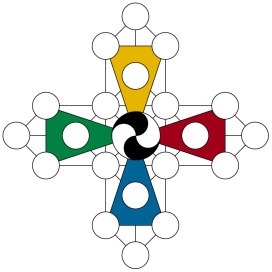
This calendar is built on the foundation of the Cardinal Directions, and has spawned a four-fold calendar system that lends itself to scaling up and down measures of time from seconds to aeons.

A diamond-oriented square containing multiple coloured squares of different sizes. The outer perimeter is four squares per side, which contains a square with four squares per side and so on. The colours alternate, but the theme is blue is down, red right, yellow top, and green left.

I Ching provides a structure by which to organize the fourfold calendar.

concentric circles - at centre, a circle divided into four quarters with an "X". From bottom moving clockwise, the colours are blue, green, yellow, red. The first circle around this is made of 16 bigrams - one line on top of the other in each of the combination of the four colours. The circle around this are the 64 trigrams of three lines. At the outside are the 256 quadrigrams.

At centre, the four directions: blue North, green East, yellow South, red West. The circles are made out of two-line, three-line, and four-line figures, or 16 bigrams, 64 trigrams, and 256 quadrigrams.

Leap Day 2020

Yeah, it’s a thing. It’s not a holiday. It’s not a celebration. It’s a mathematical fudging to keep the year kind of synchronized with the Seasons.

AFAIK, it’s the only calendar (the Gregorian/Julian) that observes the leap day anywhere other than the last day of the year.

IF February 29th were the last day of the year, then a few things would fall into place. March 1st would be the New Year. September, October, November, December, which literally mean 7th, 8th, 9th, 10th months, yet we number 9, 10, 11, 12, will actually align with their names.

It also makes it clear that the Gregorian Calendar is dedicated, at its foundation, to the Roman God of War, hence, it begins with March 1st, the month of Mars. January, named after Janus, is the two-faced god. I’ll leave you to draw your own conclusions.

also, the period of the leap day, 1 every 4 years, with exceptions 3 years out of every 400, isn’t as accurate as alternative schedules. 1 exception every 128 years is closer to the Tropical Year, and the Persian schedule is smoother.

There are an awful lot of time frames to choose from, so why do we choose this one which is so awful?