Unlike the fixed 256-day calendar, which does not apply to the Leap Day, the Scintillating 256-day calendar does. This means that every 4 years, the colours of the days of the year shift by 1, which also effects the glyphs of the 260-day calendar.
After the colours for the Cardinal Directions were assigned, it was a short matter of finding the gradation of colour between each to come up with the Prismatic Days of the Year (although, there are 360 distinct colours, as five of the 365 are repeated).
13 months of the Prismatic Year 256 quadrigrams 64 trigrams 16 bigrams
While the 4 colours represent the year for the plants.
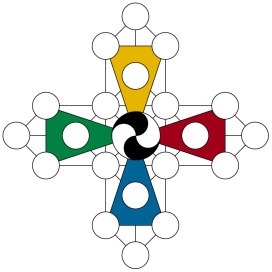
Blue – North – Winter – the blue of the sky while the plants are sleeping.
Green – East – Spring – the budding of new growth as the days warm up and grow longer.
Yellow – South – Summer – the yellow of flowers, pollen, bees, and later peppers, beans, maize.
Red – West – Autumn – the ripened red of pumpkins, apples, and leaves falling from the trees.
Assigning colours to the days is in part a step in working more colour into my artwork, but more importantly, it is to gradually note the change from day to day as the Seasons change.
Three means of changing lines around theAbysmal Wheel of the Year.
North – blue East – green South – yellow West – red
Using the above colours and the structure of the I Ching, I’ve come up with a series of images made up of stacked lines.
Circles of two-, three-, and four-line images
In the I Ching’s function as a divinatory system, a starting image is determined, and lines are changed to create a second image. The idea is to contemplate the change between the first and the second. Because the I Ching is binary, any line that changes simply switches to its opposite: dark becomes light, and light becomes dark.
Did you know that time can be represented as a wave simply by adding colours to your calendar?
Me neither.
The colours in question are colours associated with the four cardinal directions. There are any number of cultural traditions with respect to which colour is associated with which direction, and so I decided to create something anew, rather than appropriate an existing set of colours.
I applied the four colours to the time-schematic illustration below:


 Rethinking Time