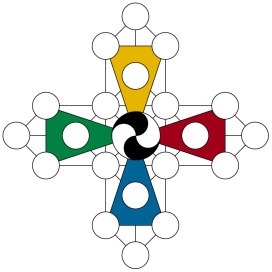
Dividing the year into 9 and 11 months, respectively.
Lately I’ve been using mathematics quite a bit in determining various ways to organize the days of the year in order to create visualizations to make the entire year easier to imagine. In this case, the sums of consecutive squares divides the year into even measures, and also allows us to visualize the days as squares.
Here are two more regular, symmetrical arrangements of the 365-day year.
9-month year
365 = 142 + 132
This creates a year that alternates between 14-day weeks (fortnights) and 13-day weeks. This creates a year of 27 weeks, which can be arranged by months of 3 weeks (alternating 41 and 40 days) and terms of 122, 121, and 122 days.

11-month year
365 = 102 + 112 + 122
Each month is 3 weeks long, although the arrangement of each is slightly different. For months 0 to 3, the months progress 12-11-10, month 4 is unique with 12-11-12, and months 5 to 8 progress 10-11-12

 Rethinking Time