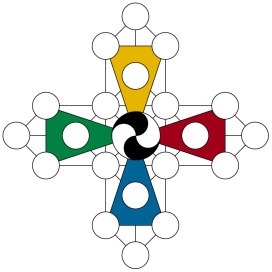
Mycelia of Life – like the Tree of Life, but more fungal.

The Symbol above is a scaffold for knowledge about time. It’s a composite of a number of different symbols and traditions, creating a syncretic-something-new.
Symbols
Ensou of Zen Bhuddism

The open circle. Think of this as the shape in which we gather as groups. The opening keeps our thoughts on those unable to attend, and allows others to join, provided room is made to keep the circle open. It’s more flexible, expansive, and inclusive than the closed circle.
Taijitsu of Daoism

the Taijitu of Daoism
A simple image that informs a sophisticated belief in the way to live within natural rhythms. The two elements, yin and Yang are complements, which is a quality that can not be overstated. The two represent idealized extremes such as pure light and pure darkness between which we experience the life of shadows, colours, pigments, arts, and so on.
Anishinaabeg Medicine Wheel
Cultures all across the world have symbol systems founded on the four cardinal directions (N, E, S, W), some include the centre, up, and down. It’s a foundation on which to build a better understanding of oneself, one’s relationship with family, community, and creation. As with the Taijitu, the symbol serves as the centre of a sophisticated system of knowledge.
Kabbalah from Judaism
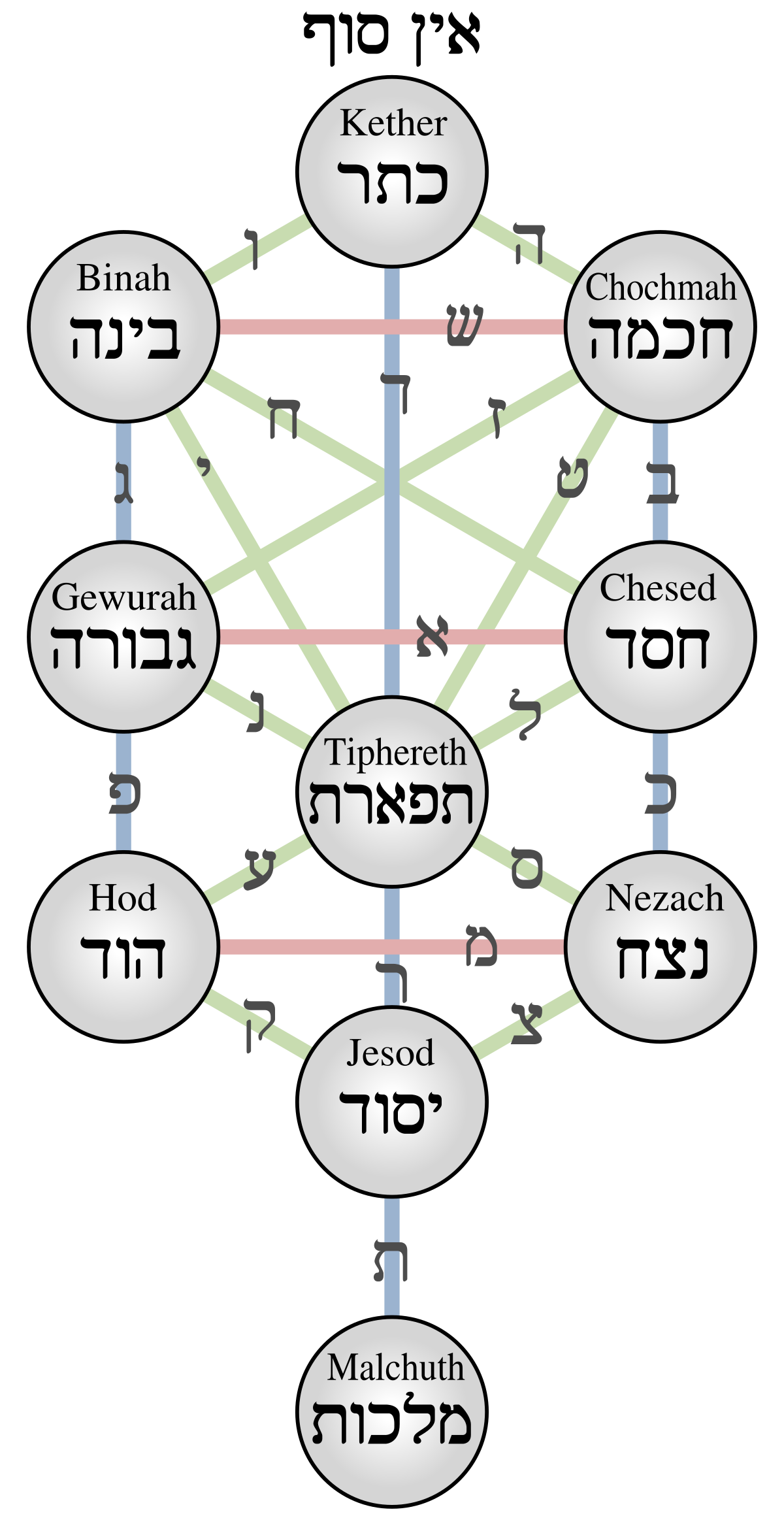
A search for the Tree of Life brought this to my attention. The spheres and paths incorporate a rich belief system, but also the letters of the Hebrew language. There is a further belief that there are four of these, overlapping one over the other, referred to as Jacob’s Ladder. The one symbol I took from the original was the central one. called תפארת, Tiferet (Spirituality, Balance, Integration, Beauty, Miracles, Compassion).
Astronomical Seasons

The 365 days of the year, shaded to represent the change in position of the Sun in the Sky throughout the year. This is the case for either Hemisphere outside of the Tropics.
Syncretic Symbol
So with the above ideas, they came together somewhere in my subconscious and came out all done. Here’s part of the process. I was pondering on the Tree of Life above, considering Tefiret as the centre, and the four overlapping Trees. How would that look if it were radial, instead of hierarchical? How would that work?

If we took the central point and the structure above it, we get the image above. Now, four of those would look like:

If we take those four and overlap the central twelve circles, we get:

Add some colour for the four direction:
| South | ||
| East |  | West |
| North |
I’ve chosen these colours for theAbysmal Calendar to reflect the plant life through the seasons here in the Eastern Woodlands of North America.
blue for the sky in Winter
green for the new buds & growth in Spring
yellow for the blooming flowers & fruit of Summer
red for the ripened fruit & leaves of Autumn

Here are the four colours applied to theAbysmal symbol. Notice at centre the Daoist black and white are a fourfold swirl. I think this better represents darkness and light as complements.
black = Down, the impenetrable darkness
white = Up, the impenetrable light
theAbysmal Calendar and the Mycelium of Life

Months of the Year
The New Year Day, Day 0 (Dec 21), falls outside of the 13 Months, which creates a gap in the calendar. This is a way to represent the Ensou, the Zen open circle, as part of the annual cycle.
The dance of light and dark ebb and flow over the Year, wax and wane with the Moon, rise and set with the Day, which is represented by the yin and Yang, Taijitsu.

By placing one of the months at the centre of the image and draw lines between the months, we get a series of lines like those in the Mycelium.


Numbering
The central swirl is meant to be theAbysmal Well, symbolically either 0 or +/- 1. There are 8 inner circles and 12 outer. These add up to 20, correlating to the XX Glyphs of the 260-day calendar (which is itself rich with symbolic associations). If we add + 1 from the centre, we get 9 inner, and 13 outer. If we subtrack -1, we get 7 and 11.
7 x 9 x 13 = 819 which is a number of days tracked by the Maya.
11 is the number of glyph XI (Raccoon) of the 260-day calendar. THere is also an 11-day week associated with the 363-day and Binary calendars.
There are 48 visible paths, 4 invisible for 52 paths in total.
Conclusion
It appears that there are opportunities for us to create a new language of symbolism that resonates with our pre-existing ones without displacing them. This mycelium of life such as it is, is one such attempt, and in truth, only a beginning.
 Rethinking Time