the very basics
Elements describe pre-existing conditions for our being: the Sun (fire), the Earth, atmosphere (air), oceans (water). These are the essentials for life, which can be further elaborated into categories like plants, fungi, animals. In scientific terms, we speak about atoms and elementary particles.
Ancient Elements
the First Pair

If we’re going to categorize aspects of the ineffable chaos of existence, the binary complements of Dark and Light are as good a start as any.

Dao is an expression of the ebb and flow of light and dark.

I Ching is a divination system that uses two types of lines, light and dark in the image above.

binary codes at its simplest is composed of 0s and 1s.
Four plus One Elements
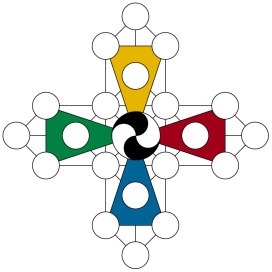
These four elements appear to be the most common, used in Europe, the Middle East, Central and North America. The four elements are Earth, Air/Wind, Water, Fire, and sometimes a fifth is added, Void/Space/Aether, at centre.
| Fire | ||
| Earth |  | Water |
| Air |
The elements are associated with the Cardinal Directions and Seasons in many systems. The relationships between direction, colour, season, and element are diverse.
In theAbysmal system:
- Air is blue North/Winter
- Earth is green East/Spring
- Fire is yellow South/Summer
- Water is red West/Autumn.
- Aether sits at colourless Centre.
Looking at our global environment:


Atmosphere (Air) – Lithosphere (Earth) – Magnetosphere (Fire) – Hydrosphere (Water)
East Asian Elements
The five elements in the Chinese system are Wood, Fire, Earth, Metal, and Water. There are a number of relationships between them, however, the image below follows the clockwise progression of Generation and the star’s path follows the progression of Overcoming.

Chemical Elements
The Standard Model of Elementary Particles provides us with the building blocks for the chemical elements listed in the tables that follow. (images from wikipedia)
Elementary Particles

Chemical Elements
I appreciate this astronomer’s periodic table which colour-codes the origins of the element.

Rethinking the Periodic Table
A number of alternative periodic tables have been constructed in order to arrange the elements in order to emphasize different characteristics and relationships.


Mythological Elements
Although the ancient elements listed above are an important aspect of Mythsystems, the following are derivative. In a sense, the Four Cardinal Elements are necessary for the Mythological Elements to exist, and those are necessary in order for us to exist.

Trees of Life
Etz Chaim, Yggdrasil, Somb, Kalpavriksha, Bohdi, Fusang, Wacah Chan, Yax Imix Che, Nookomis Giizhig, Skaronhiase’kó:wa.
Tree of Life, Tree of Knowledge, Tree of Death, Tree of Immortality, Tree of Peace. There is an entire forest of such trees. The character for the Chinese element, Wood, means “tree”.


Holy Metal
Meteorites, gold, silver, iron, steel all play important roles historically, however, it is what we make out of these metals that become representative: the Black Stone at the centre of the Kaaba, gold thread, silver mirror, iron cauldron, steel sword.
the Esoteric tradition associates an object with each of the four elements.
| Fire Staff | ||
| Earth Disc | | Water Cup |
| Air Sword |

 Rethinking Time