
The idea of “myth” has taken a beating over years. It has come to be synonymous with falsehood in the “truth vs myth” framework, or with apocryphal or ancient stories of Gods and fantastical creatures. What I want to do here is develop a myth-system, which is an interconnected series of stories that provide knowledge and skills through several overlapping layers of narrative.
In a sense, it’s an integration of all the rest of this site and its meandering collection of ideas. Hopefully, settlers will redefine ourselves locally/regionally within Indigenous Territory, which requires a far different sense of self and community than we have developed so far. A living mythsystem incorporates history, so there’s no pretending we’re not settlers and foregrounds Indigenous history. It incorporates codes of behaviour, psychological guidance, pragmatic advice, and a language of colour, symbol, music that weaves its way into society as referents. In a living myth-system, we adorn ourselves, decorate our homes, and celebrate the holidays using these colours and symbols. It has the effect of evoking the story world into the world around us, and when most potent, is like living in a dream.
“My people will sleep for one hundred years, but when they awake, it will be the artists who give them their spirit back.”
–Louis Riel

It’s a far cry from the increasing presence of transnational franchises and automobile infrastructure that surrounds me. These, too, are part of an industrial mythsystem, dictated by the wealthy through marketing, advertising, propaganda, education, social engineering rather than evoked through community.
Stories within a mythsystem aren’t crafted like fiction, but rather stories emerge as layers of meaning are overlaid. In a thriving culture, the mythsystem would replace institutions like education, as lessons are embedded everywhere. It’s a holistic system that evolves with the world and our place in it.
It’s a slow process.
Mythsystems
As Sean Kane explores in Wisdom of the Mythtellers (Broadview 1998), stories within mythsystems use patterns, maps, boundaries, dreams, complementarity, tradition, and context to inform the narrative. Myths can weave together pragmatic survival skills, social norms & customs, interrelationships, histories, geographies and origins. In part, it’s what brings us back to these stories over and over. At progressive stages of our lives, there’s a different message in the familiar tale, something like adult jokes in children’s programming.
I expect this to develop locally, collaboratively, and slowly, however, having a time-system established provides such a valuable framework for everything else. I often wonder if the Story of the Year was our second myth after What Is All This?
Below, some examples from established mythsystems, followed by elements and symbols already provide some foundation to grow from.
Anishinaabeg, Hindu, Grecian Myths
the Aninishinaabeg Creation Story is the tale of Sky Woman and Turtle Island. This is the story of how this part of the world came into being, and it is immeasurably older than English, Latin, Greek or the other conventional starting places.
The Hindu epic Devi Mahatmyam (also called Durga Saptashati) is the Glory of the Goddess, an important myth in the Shakti sect. As an outsider, Hindu Mythology is an overwhelming, scintillating, kaleidoscoping cascade of motifs, variations, incarnations, to the point where one’s mind stops trying to keep track and enters a meditative state.
Text of Devi Mahatmyam – the Glory of the Goddess

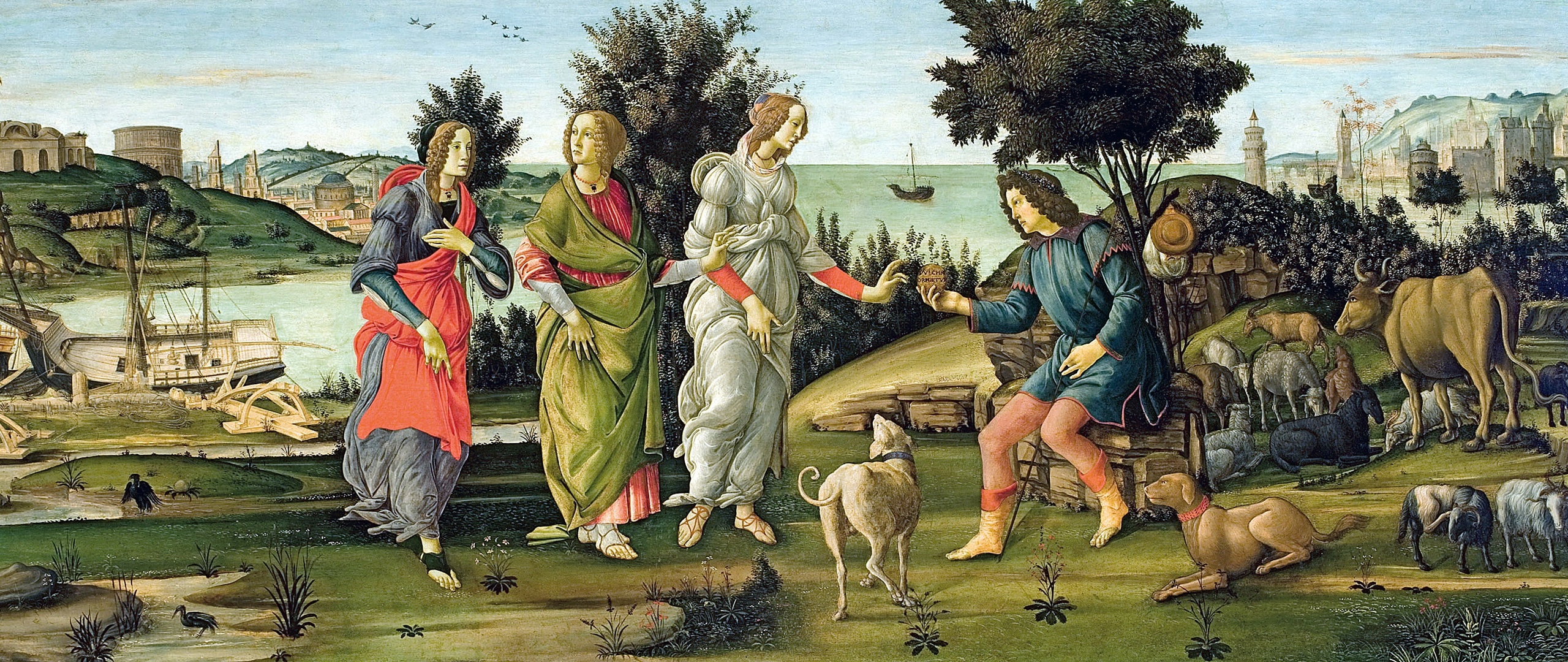
the Judgment of Paris refers to the Grecian myth of how the Trojan War began. Eris, goddess of stirring the pot, was the only Olympian not invited to the wedding of Peleus & Thetis (future parents of Achilles). So she went to the sacred garden, plucked a golden apple, marked it with “For the Fairest”, and threw it into the party.
Paris was enlisted to judge which goddess should receive the apple: Hera, Athena, Aphrodite. The goddesses offer him boons/bribes, and he awards the apple to Aphrodite (typical). She rewards him with the love of Helen of Troy, the most beautiful women.
Menelaus: “Um…”
And so the Trojan War begins – which I’ve been told is “the granddaddy of them all.” The more I think on it, the more it’s the origin of Western mythology, moreso than the Book of Genesis. The tale of the golden apple from the sacred Tree in the sacred Garden is a powerful common element to both.
Eris is the goddess of spite, discord, and stirring the pot, and depending on one’s allegiances, She might even be on your side.
As with any interaction with the divine, handle with care. Details matter.
the Integrated Body
The central part of any mythsystem is the individual human being as participant. Each of us is the centre of perception for our own experience of life in the universe, collectively, we offer multiple overlapping points-of-view.
Rather than thinking of the body predominantly in anatomical terms, I’ve increasingly been integrating the physical, emotional, and cognitive. In the process, I’ve discovered how our bodies use mental images to communicate with the mind, similar to dreams in some ways. It has been invaluable in healing some very old, very deep wounds.
Part of the role of the elements woven into a mythsystem is to evoke mental images we hold collectively as a community. This is common in religious symbols, for example.
Myths are a form of collective storytelling, and participation requires re-examining one’s role in relation to everyone else.
more to follow…
Elements
As theAbysmal cobbles itself together, consider the Tibetan Kalachakra Mandala, the Wheel of Time, as a non-linear myth.

It embodies pattern, complementarity, context, map, boundary, dream, and tradition.
Stories themselves are evoke orally, so I won’t be writing out any myths here. There are symbols that have developed through exploring theAbysmal Calendar that will certainly be incorporated into the greater system.
A few examples:
Pattern

Complementarity

Context

Map

Boundary

Dream

Tradition

Tree
As I live in the Eastern Woodlands of North America, stories featuring World Trees, Great Trees, Trees of Knowledge, or Immortality, or Life seem appropriate. Here are a few that populate our syncretic woods.
While the Tree provides a world axis in mythological terms, a living mythsystem includes a physical tree for holidays. Gathering around the communal Christmas tree to feast and sing together. If properly evoked, that physical tree becomes the World Tree as our world overflows with wonders.

Skaęhetsiˀkona – Haudenosaunee eastern white pine, Great Tree of Peace
wacah chan/yax imix che – Maya ceiba Tree
Yggdrasil – Norse ash Tree
Mílon tís Éridosthe – Grecian Apple of Discord
êṣ had-daʿaṯ ṭōwḇ wā-rāʿ – Jewish Tree of Knowledge of Good & Evil
êṣ ha-ḥayyîm – Jewish Tree of Life
Shajarat al-Khold – Muslim Tree of Immortality
Kalpavriksha – Hindu/Jain/Buddhist Tree that grants boons
Ashvattha – Hindu fig Tree
Bodhi Tree – Buddhist fig Tree of Awakening
Gaokerena – Persian plant that grants immortality
Fú Sāng – Chinese mulberry Tree of Life
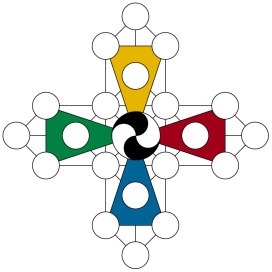
theAbysmal Tree bears similarities to many of those listed above.
- 4 main branches indicating cardinal directions
- 13 celestial branches total
- 9 underworld roots
- 7 earthly elements of the trunk
- the uppermost root overlaps with the lowest part of the trunk
- the lowermost branch overlaps with the highest part of the trunk
- 4 + 8 + 1 + 5 + 1 + 8 = 27 stations on our mythological Tree
4 coloured triangles = main branches
12 outer circles = celestial branches
8 inner circles = underworld roots
Central circle = earthly trunk
Many Trees present a hierarchical image, however, theAbysmal developed out of a radial pattern which better represents the Tree as a node in the forest’s mycorrhizal network.
Garden
The Tree lives in a sacred Forest, or Grove, or Garden, which itself is a mythological map of the local geography.
This includes local Flora, Fauna, Fungi, and most importantly, their relationships with the Seasons and one another. We need them to survive, however, they don’t need us. It’s important to make distinctions between Indigenous plants, naturalized plants, and invasive species.
Trickster
Tricksters are essential to any mythsystem, and Raccoon is the Trickster who found theAbysmal.

Symbols
Symbols derived from mythsystems carry a weight of meaning with them. Consider:


- Elements – Air, Earth, Fire, Water, Wood, Metal, Spirit, Aether, chemical elements
- Symbol and Meaning – a few symbols developed for theAbysmal mythsystem
- theAbysmal Symbol – how theAbysmal symbol came together
- Kalichakra Mandala – theAbysmal Mandala of Time
 Rethinking Time