By a fortunate coincidence (amazing how many of these keep turning up), the Leap Day occurs during theAbysmal 13-month Calendar’s Rabbit Year, which is determined by the glyph from the 260-day calendar that falls on the Dec 21 new year. Just so we’re clear, Dec 21 2023 was 12~VIII (Rabbit). Dec 21 2027 will be 3~VIII (Rabbit), 2031 will be 7~VIII, 2035 will be 11~VIII and so on.
The Leap Day is observed as part of theAbysmal Calendar’s Fixed and Scintillating Years (see All the Years for details). These calendars keep aligned with the Seasons, i.e. the Solstices and Equinoxes, and to do so, we observe this periodic Leap Day. With the Fixed Year, the Leap Day is a blank – it falls between the weeks, isn’t part of any month, doesn’t bear a colour, number, or glyph from the 260-day calendar. It’s a hoppy holiday. In the case of the Scintillating Calendar, a colour is assigned to the Leap Day, but none of the other measures. Today’s colour is green (East). This scheme is what lead to the 256-day calendar.
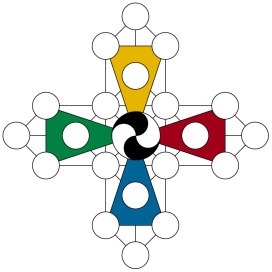
Today, Nov 5, marks the mid-quarter day on the 364- and 360-day calendars of the Fixed and Wandering Years. In the image below, it is represented by the large purple circle just down and right from the central blue circle on Dec 21.
It falls about midway between the Equinox and the Solstice, and among other things, represents the shift from the shortening days of Autumn to the long nights of Winter.
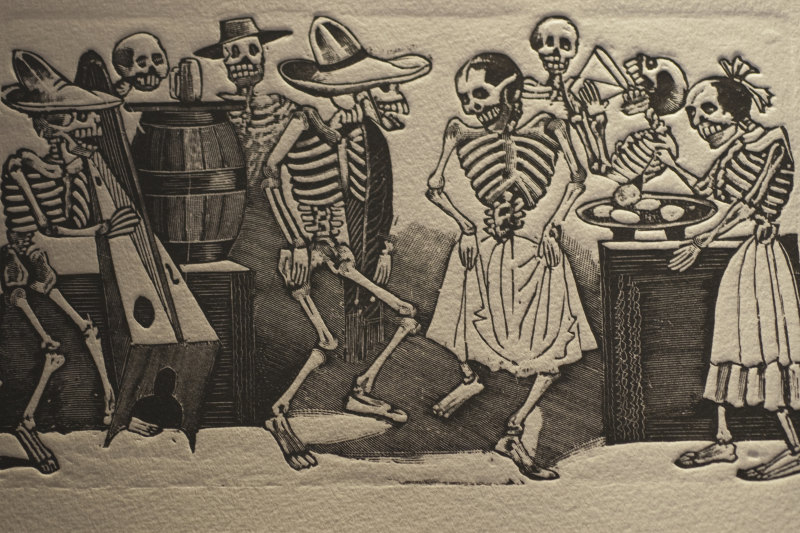
There are a number of traditions, beyond the attempt to bomb Parliament (‘member?). Halloween, the Days of the Dead and Remembrance Day are all ceremonies for the Dead, Ancestors, the Spirit World. They span a 13-day period from Oct 30 to Nov 11, with the middle date occurring today, Nov 5.
Another tradition, one that we would do well to revive, is to move indoors and tell stories through the Winter. While media provide us with an abundance of stories, sharing stories with one another is a richer experience, provided the stories are of a type. Properly done, this would be the equivalent to the school period. Some traditions begin with the first snowfall, however, given the uncertainty of the weather in future, today is also a good demarcation, as we descend into darkness, and gather to share a little light.
The opposite end of this is Feb 5, equivalent to Groundhog’s Day, when the hibernators look outside through blinking eyes and decide whether to go back to bed or not.
For those of us following theAbysmal 260-day Calendar, today marks 11~XIX (Storm), which falls 260 days after the previous 11~Storm, Sep 8 2022, the day of Queen Elizabeth II’s death.
Her death signifies more than a change in the monarchy, but also the end of an era. The manner in which the royal family has held so much of the world in thrall is over, and the matrix, as it were, is falling to pieces.
There’s a lot to celebrate come Sep 9, the day of our liberation. There’s even more to celebrate between now and then.
From Queen Victoria to Queen Elizabeth, the monarchs of Canada have principally been Queens – we don’t commemorate Edwards VII & VIII, nor Georges V & VI the way we do Victoria and Elizabeth. Small wonder given the lengths of everyone’s reign. Victoria reigned over Canada from 1867 to 1901 (34 years of 65 as Queen), Edward VII for 9 years, George V for 26, Edward VIII for 1, George VI for 16, Elizabeth II for 70, almost half of Canada’s history.
Kings: 52 Queens: 104
Roughly 2/3 of the short time Canada has existed, it has been ruled by 2 Queens.
the Queen is dead, and Charles III is no monarch of Canada, despite what parliamentarians think. (vote results “to sever ties between the Canadian State and the British monarchy,” – defeated: 266 to 44)
Did you know that QE2’s death on Sep 8 2022 fell between Sep 7, aka theAbysmal Year Day 10~XVIII (Mirror) and Sep 9, aka theAbysmal 13-Month Calendar’s Year 9 Month 9 Day 9?
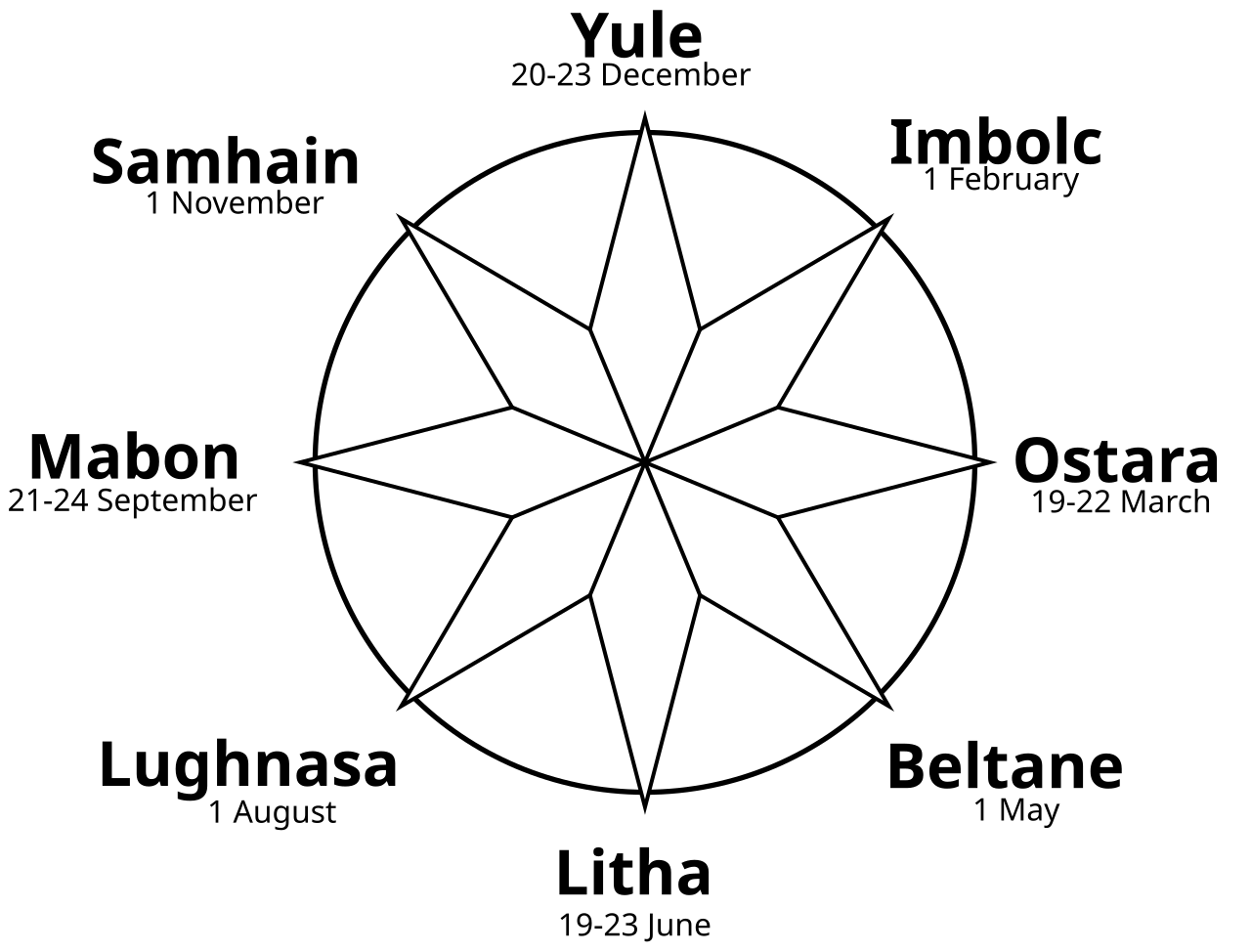
the Wheel of the Year is an ancient way of dividing the year by the seasons: Solstices, Equinoxes and their midpoints. Currently, the Gregorian Calendar is used by Neopagan groups, so the Wheel of the Year is fixed around the observed Solstices & Equinoxes, and midpoints on fixed dates: Feb 1, May 1, Aug 1, Nov 1.
With theAbysmal Calendar, the observed Solstices and Equinoxes are part of the Lunisolar Calendar , whereas theAbysmal Wheel of the Year is about using the 7 days of the week to help us better imagine the year, and better anticipate what’s to come.
Firstly, theAbysmal divides the year into 52 weeks plus 1 day. The one day falls on Dec 21 and marks the New Year. The remaining 52 weeks of the year are divided into 4 quarters of 13 weeks each, or 91 days. this means that the first day of the quarter falls on the same Weekday.
For example, in 2020-2021, Dec 22 fell on Tue, so Mar 23, Jun 22, and Sep 21 all fall on Tue. If Tue begins the week, then the midweek day falls on Fri.
The four midquarter days fall in the middle day (Fri in 2021) of the middle week of the quarter. Each midquarter day falls precisely 45 days after the start of the quarter, and 45 days before the end of the quarter.
This level of precision is not a feature of the Gregorian Calendar.
theAbysmal Calendar’s Wheel of the Year oriented for the Northern Hemisphere Begin at bottom at the Winter Solstice, and proceed clockwise.
For those of us in the Northern Hemisphere, this marks about the time we celebrate Imbolc and Groundhog Day. Groundhog Day in particular is interesting symbolically speaking. In the illustration above, Feb 5 falls midway between Dec 22 and Mar 22. It is the middle of 13 weeks, which means 6 full weeks have elapsed and there’s 6 more to go. Imagine the Groundhog emerging after the Winter: either they look toward Spring, that is, toward the Sun, in which case they don’t see their shadow, or they look toward Winter, away from the Sun, when they see their shadow.
Our relatives in the Southern Hemisphere don’t get enough consideration when it comes to how we talk about the Seasons globally. The Northern and Southern Hemispheres experience the complementary season to each other: Northern Winter coincides with Southern Summer.
theAbysmal Calendar’s Wheel of the Year oriented for the Southern Hemisphere Begin at top at the Summer Solstice and proceed counter-clockwise
in the Southern Hemisphere, this would be the equivalent of Lughnasadh at the end of Summer and turning to the shortening days of Autumn.
Equalnights
Despite its name, the Equinox is not the date when day and night are the same. These Equalnights vary depending on the line of latitude where you live.
from this Midquarter day to the end of the quarter Equalnights take place from the Equator to the North Pole. From the start of the quarter until the next Midquarter day (May 7), Equalnights take place from the South Pole to the Equator.
theAbysmal Year Days fall 260 days from the New Year (Dec 21).
There are definitely 8 Rabbits celebrating on this tiny rustic table.
As a function of how the 365-day and 260-day calendars coincide, there are 2 year days during any given calendar year: one occurs 260 days before the New Year on Apr 5 (4 in a leap year), the other 260 days after the New Year on Sep 7 (6 in a leap year for now).







 Rethinking Time