Tesselations of the Days of the Year
There’s a new page, Tesselated Time, that uses tiling to create artistic renderings of theAbysmal Year.

Tesselations of the Days of the Year
There’s a new page, Tesselated Time, that uses tiling to create artistic renderings of theAbysmal Year.
colouring the days of the year
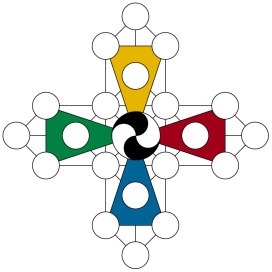
The 256-day calendar assigns a colour to each of the days of the year in the sequence red-yellow-green-blue.
To help illustrate this, theAbysmal uses quadrigrams, i.e. images created by stacking four lines, each of which is one of the colours, resulting in 256 distinct images.

Coloured patterns within the Fixed Years of theAbysmal Calendars
see: All the Years, 256-day Calendar
In a previous post, Waves in the Ocean of Time, we took a look at the regular patterns generated by the colours of the 256-day calendar. The waves were generated by looking at the first month of theAbysmal Calendar’s Fixed Years over the course of 4 years.
The ripples below are generated by following the months of the 360-day calendars within each year over the course of 4 years. Rather than the waves, which move laterally or diagonally from right to left, the ripples create a variety of patterns owing to the various skipped days.
360-A calendars


Emergent Patterns in the Colours of the Days
see also: Ripples in the Ocean of Time
The 256-day calendar assigns a colour to each day of the year in the sequence Green-Blue-Red-Yellow. When the days are organized by week (5 to 13 days) and those weeks into months (15 to 60 days), certain patterns emerge.
Looking at the first regular month of every Fixed Year, they cycle through four variations, each of which generates a regular, repeating pattern.


Both of these give the impression of waves moving diagonally downward and upward respectfully.
Continue reading Waves in the Ocean of TimeGeometric Time in 1- and 2-Dimensions
Figurate numbers are a mathematical way to represent various geometric shapes: triangle, square, pentagon in 2-dimensions; tetrahedron, cube, icosahedron in 3-dimensions; pentatope, and hypercubes in 4-dimensions; 2-d and 3-d fractals in their own pseudo-dimension. For the moment, let’s take a look at 0-, 1-, and 2-d representations of the months (15 to 60 days).
For the mostpart, theAbysmal Calendar represents the months of its various years as rectangles. The 13-month calendar’s months are composed of 4 weeks of 7 days, which creates a 4 x 7 rectangle. Beyond these, there are many other variations possible, and while they are aesthetic, there are some practical functions as well.
Continue reading Figurate Calendars IA few possible arrangements of the fixed year
theAbysmal Calendar is an ongoing experiment in exploring time, art, calendars, and mythology as means of founding interdependent relationships between communities.
While the basic structure of theAbysmal Calendar is aligned with the Solstices & Equinoxes, the goal has been to harmonize as many of the features used in calendars and daykeeping systems. Many of these arrangements are used elsewhere, however theAbysmal synchronizes all of its measures to the Seasons.
the Lunar Calendars count all of the days, lunar months, and years without exception. All observational phenomena (planetary cycles, comets, precession, solar cycles, etc.) are recorded here.
the Solar Calendars that follow are regular divisions of the 365-day year.
Market Week Calendars are synchronized to the 365-day year, but repeat themselves along shorter periods, and synchronize with the solar year over longer periods.
Continue reading Calendar Galleryanimation of month 6 over 28 years
The most compelling harmony between the 13-month calendar and the weekdays generates a cycle that repeats itself every 28 years.
Every 4 years a Leap Day is inserted halfway through Month 6 – although the Leap Day isn’t part of the month, it is still assigned a weekday, and so every Leap Year, half the year begins with one weekday, and the second half begins with the next.

clearly, I’m no graphic designer.
visualizing the year – because Time is Art
Hello friends. I’ve been experimenting with different ways to represent the year, in order to make our time more easily navigable. In the end, I’ve sort of fallen down a rabbit hole of patterns, numbers, and shapes.
Currently, I’m looking at tesselations – those shapes that fit together, like MC Escher’s art, and quilts.

Each arrow is shaded a unique colour, each of which is assigned to a particular day of the year. The above image is, among other things, a calendar.
Through feats of mathemagic the days of the year make a series of Sierpiński triangles.
365 = 30 + 31 + 32 + 33 + 34 + 35 + 1
Taking this particular formula, the question becomes how to take a sequential progression of days to make of it some geometric structure. Adjusting the formula, we get:
365 = 1 + 31 + 32 + 33 + 34 + 35 + 1
= 363 + 2
theAbysmal 363-day calendar,provides a framework for this to sort itself out. The +2 days fall on Apr 5 and Sep 7. These last two dates fall 260 days from Dec 21 (the New Year Day of the 13-Month Calendar). As a result, Apr 5 has the same Number~Glyph as the coming in new year in 260 days, whereas Sep 7 has the same Number~Glyph as the previous new year 260 days ago. Apr 5 looks ahead to the future, Sep 7 looks back at the past.
The fractal image is presented here as 2-dimensional, but it creates a 3-D model of a fractal tetrahedron, with the final point occurring at Apr 5. This provides us a greater vantage to see further (farther?) into the future.

Each triangle represents one day. It’s shaded according to the prismatic year, where
Green = East & Spring
Yellow = South & Summer
Red = West & Autumn
Blue = North & Winter
Beginning at bottom left, progress up and down each trio of triangles to follow the day-to-day progress from Apr 6 all the way to Apr 5, the inverted triangle at right (Sep 7 is not included).
I imagine it as slowly but surely building a pyramid over the course of the year, to climb atop and get a better vantage of the distant future. The thing is, as each year passes, another one of these is completed, such that after three years, we have another level. After 9 years, yet another. 27, 81, 243 years all raise us to greater perspective.
Here’s the map of the dates:

Adding a little colour to our days.
After the colours for the Cardinal Directions were assigned, it was a short matter of finding the gradation of colour between each to come up with the Prismatic Days of the Year (although, there are 360 distinct colours, as five of the 365 are repeated).

hile the 4 colours represent the year for the plants.
Blue – North – Winter – the blue of the sky while the plants are sleeping.
Green – East – Spring – the budding of new growth as the days warm up and grow longer.
Yellow – South – Summer – the yellow of flowers, pollen, bees, and later peppers, beans, maize.
Red – West – Autumn – the ripened red of pumpkins, apples, and leaves falling from the trees.
Assigning colours to the days is in part a step in working more colour into my artwork, but more importantly, it is to gradually note the change from day to day as the Seasons change.
 Rethinking Time