A few possible arrangements of the fixed year
theAbysmal Calendar is an ongoing experiment in exploring time, art, calendars, and mythology as means of founding interdependent relationships between communities.
While the basic structure of theAbysmal Calendar is aligned with the Solstices & Equinoxes, the goal has been to harmonize as many of the features used in calendars and daykeeping systems. Many of these arrangements are used elsewhere, however theAbysmal synchronizes all of its measures to the Seasons.
the Lunar Calendars count all of the days, lunar months, and years without exception. All observational phenomena (planetary cycles, comets, precession, solar cycles, etc.) are recorded here.
the Solar Calendars that follow are regular divisions of the 365-day year.
Market Week Calendars are synchronized to the 365-day year, but repeat themselves along shorter periods, and synchronize with the solar year over longer periods.
theAbysmal Lunar Calendars
theAbysmal uses two lunar calendars: one that counts every measure linearly, and another that relates days to the lunar month, and lunar month to the year.

Lunar Calendar
this is a linear count of days, Moons, Years as well as periodic astronomical phenomena (planetary cycles, eclipses, etc).
theAbysmal Epoch began May 26 1492, however, theAbysmal Era 2 began Jun 19 2012, and the numbers count from this date.


Lunisolar Calendar
the Lunisolar Calendar numbers the Moons of the Year 0 to 11 or 12, and the Days of the Moon 0 to 28 or 29.

Year 9, Moon 11, Days 0 to 29
theAbysmal Solar Calendars
theAbysmal Solar Calendars are synchronized with the Seasons. While many of these are the result of dividing the year into equal numbers of weeks and months, others resulted from experimenting with mathematical formulas.
First, the Wheel of the Year which frames the symmetrical solar year.
Second, the more familiar “months” of the year, where the formula is presented as:
365 = months/year x weeks/month x days/week + additional days
Weeks range from 5 to 13 days.
Months range from 3 to 5 weeks.
These are represented as regular rectangles.
Third, irregular months – those with weeks of different measures.
Fourth, accelerating weeks – these are weeks that become progressively longer and shorter through the year. These are triangle numbers.
Fifth, experimental divisions of the solar year.
Sixth, market week calendars, which apply symbols to the days.

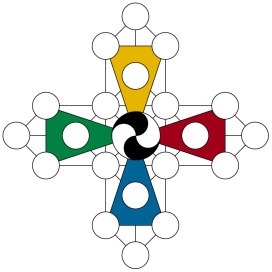
N.B. there are two colour patterns. The first are the four colours for the cardinal directions: blue North, green East, yellow South, and red West. The second assigns a shade to each of the 365 days of the year, represented as circles.
Wheel of the Year
365 = 4 x 91 + 1

Regular Months of the Year
24-Hōra Year
365 = 24 x 3 x 5 + 5

20-Month Year
365 = 20 x 3 x 6 + 5

18-Month Year
365 = 18 x 4 x 5 + 5

15-Month Year by 6-day week
365 = 15 x 4 x 6 + 5

15-Month Year by 8-day week
365 = 15 x 3 x 8 + 5

13-Month Year
365 = 13 x 4 x 7 + 1

12-Month Year by 6-day week
365 = 12 x 5 x 6 + 5

12-Month Year by 10-day week
365 = 12 x 3 x 10 + 5

11-Month Year
365 = 11 x 3 x 11 + 2

10-Month Year by 9-day week
365 = 10 x 4 x 9 + 5

10-Month Year by 12-day week
365 = 10 x 3 x 12 + 5

9-Month Year by 8-day week
365 = 9 x 5 x 8 + 5

9-Month Year by 10-day week
365 = 9 x 4 x 10 + 5

8-Month Year
365 = 9 x 5 x 8 + 5

7-House Year
365 = 7 x 4 x 13 + 1

6-Month Year
365 = 6 x 5 x 12 + 5

Irregular Months of the Year
19-Month Year
365 = 192 + 4
= 19 x (6 + 7 + 6) + 4

13-Month Year
365 = 52 + 132 + 132 + 2

11-Month Year
365 = 102 + 112 + 122
= 5 x (12 + 11 + 10) + (12 + 11 + 12) + 5 x (10 + 11 + 12)

9-Month Year
365 = 132 + 142
= 5 x (14 + 13 + 14) + 4 x (13 + 14 + 13)

Accelerating Divisions of the Year
In mathematics, these are triangle figurate numbers. In practice, they create a series of weeks where each successive week is one day shorter than the previous, until it gets down to 1, then the following measure is one day longer until reaching the maximum.
24 Hōra
365 = 24 x (5 + 4 + 3 + 2 + 1) + 5

13 Months (28)
365 = 13 x (7 + 6 + 5 + 4 + 3 + 2 + 1) + 1

10 Months (36)
365 = 10 x (8 + 7 + 6 + 5 + 4 + 3 + 2 + 1) + 5

8 Months (45)
365 = 8 x (9 + 8 + 7 + 6 + 5 + 4 + 3 + 2 + 1) + 5

4 Quarters
365 = 4 x (13 + 12 + 11 + 10 + 9 + 8 + 7 + 6 + 5 + 4 + 3 + 2 + 1) + 1

3 Terms
365 = 3 x (15 + 14 + 13 + 12 + 11 + 10 + 9 + 8 + 7 + 6 + 5 + 4 + 3 + 2 + 1) + 5

Square Divisions of the Year
The 365 days of the year can be organized as a series of squares – from the 4-day and 9-day weeks, to the 36-day month, and 361-day year.
10-Square Year
365 = 10 x 62 + 5

1-Square Year
365 = 192 + 4

3-D Divisions of the Year
Tetrahedral Year
365 = 364 + 1
= 1 + 3 + 6 + 10 + 15 + 21 +28 + 36 + 45 + 55 + 66 +78 + 1
= 1 +
2 + 1 +
3 + 2 + 1 +
4 + 3 + 2 + 1 +
5 + 4 + 3 + 2 + 1 +
6 + 5 + 4 + 3 + 2 + 1 +
7 + 6 + 5 + 4 + 3 + 2 + 1 +
8 + 7 + 6 + 5 + 4 + 3 + 2 + 1 +
9 + 8 + 7 + 6 + 5 + 4 + 3 + 2 + 1 +
10 + 9 + 8 + 7 + 6 + 5 + 4 + 3 + 2 + 1 +
11 + 10 + 9 + 8 + 7 + 6 + 5 + 4 + 3 + 2 + 1 +
12 + 11 + 10 + 9 + 8 + 7 + 6 + 5 + 4 +3 + 2 + 1 +
1


Experimental Divisions of the Year
Binary Year
365 = 20 + 22 + 23 + 25 + 26 + 28
= 1 + 4 + 8 + 32 + 64 + 256

Sierpiński Year
365 = 30 + 31 + 32 + 33 + 34 + 35 + 1
= 1 + 3 + 9 + 27 + 81 +243 + 1

Multi-Year Calendars
27 months over 2 years
36 = 272 = 729
729 + 1 = 730 = 2 x 365


27 months of 27 days over 2 years
8 months over 3 years
3 x 365 = 17 x 26 + 7 = 1095 days

Trying to accomodate the 17-day period.
Market Week Calendars
These calendars provide symbolism to the days. they are synchronized with the 365 days of the year, and so do not apply to the Leap Day.
260-Day Calendar
260 = 13 x 20

256-Day Calendar
256 = 4 x 4 x 4 x 4
= ((22)2)2

 Rethinking Time