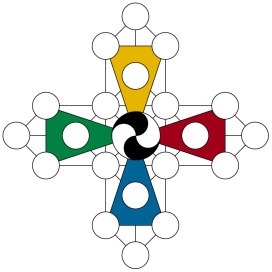
This may be an original calendar idea.
365 x 2 = 729 + 1 = 36 + 1
729 is a wonderful number in terms of 3s and 9s, and odd numbers all around. It allows for 27 months of 27 days over the course of 2 years. Each month is 3 9-day weeks and 9 3-day weeks.
As with most of theAbysmal Calendar, there are several versions: fixed, wandering, scattering.
Fixed 729+1
The fixed 729-year (granted, it’s a biennial) observes a leap day as well as a skip day every cycle. The skip day was initially set at Dec 21, however, when arranged in this manner, the leap day disrupts the month and week in which it occurs.
Instead, the first day of the calendar falls on Jun 22. The first biennal has a Skip Day 2/3 of the way through the cycle. The second biennial has a Skip Day 1/3 of the way through the cycle. The Leap Day falls on Jun 21 at the end of the second cycle.
4 years
1461 days = 3 x 487 = 2 x 729 + 3 = 3 x 486 + 3 = 6 x 243 + 3
Skipped Days
486 // skip Feb 21 \\ 486 // skip Oct 20 \\ 486 // leap Jun 21
729 = 272 = 93 = 36


Note: the illustrations above place the New Year at Dec 21. Updates pending.
Wandering 729+1
The Wandering calendar doesn’t use a leap day, and so it is aligned with the Wandering 364+1-day calendar. The first New Year was Dec 23 2012. The Wandering and Fixed 729-day calendars had the same New Years on Dec 21 2022 and 2024.

Scattering 729
The Scattering calendar doesn’t fit the 360,360-day harmonic. This means that although the canonical Scattering 729-day calendar began Jun 19 2012, versions of it can be started at any date. Ideally, the 9-day week of both the 729-day calendar and 360,360-day harmonic begin on the same day.
Regardless, the Scattering 729-day biennial has neither leap day nor skip day.
Scales of 3
The 729-day calendar scales beautifully, as it repeats its 3-fold layers over orders of magnitude.

The image above represents a scaling of the 3-fold year. The central blue square represents 1 day. The middle blue square represents one 729-day cycle. The outside blue square represents 729 cycles of 729 days (531,441 days). Inside the middle square, the numbers count days, outside the square, they count 729-day cycles.
At centre, we have a day, as well as the days before and after to make a 3-day week. Add to this the previous and following 3-day week, i.e. the periods above and below our central day, we get a 9-day week. Add the previous and following 9-day week, we get a 27-day month. And so on.
As a matter of scaling, the central day can apply to any measure, from 3 days week to 531,441 days. This seems to suggest time in both directions, equidistant from the current moment.
Yesterday, Today, Tomorrow is ever our 3-day week.
theAbysmal, 11~III, 10~10~10

729-260 days
The way the 729-day calendar frames the 260-day calendar is interesting. The first, middle, and last days of the 27-day month, all bear the same number (1-13 from the 260-day calendar).
Say, for example, the first day of the 729-day cycle falls on 1~I (Turtle), the first day of the 260-day calendar.
- The first, middle, and last days of the year all bear the number 1
- The first, middle, and last days of the first, middle last months all bear the number 1
- The number progresses by 1 for each successive 729-day cycle.
Because 729 and 260 days do not share any factors, a calendar round is 260 cycles, or 189,540 days (about 520 years).


27 Hours per Day
The 27 months of 27 days can be extended to 27 hours per day. This means that rather than 3600 seconds, each hour is reduced to 3200 (53 min. 20 sec.) Unfortunately, this leaves us with 40 “minutes” of 80 seconds, or alternatively, 80 “minutes” of 40 seconds.
 Rethinking Time