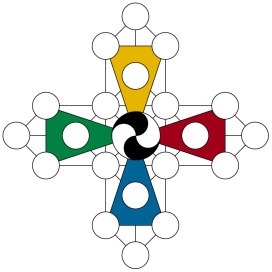
Using the 8-fold model for weeks, months, and years.
This is a continuation of one of the ideas introduced in Calendar Building.
Slicing Time

Here we have the days of the year divided into equal quarters of 91 days with the midquarter days marked. Each of these days sits 45 days from the beginning and 45 days from the end of the quarter. Each quarter is also 13 weeks, so these midquarter days also fall in the midquarter week, which sits 6 weeks from the beginning and 6 weeks from the end of the quarter. In addition, the midquarter day falls on the middle day of that middle week.
It’s all very synchronized.
The configuration above is a version of the Wheel of the Year.

The image above represents natural time as a waxing from darkness to light, and waning from light to darkness – this applies to the day, the moon, and the year.
As with much of theAbysmal Calendar, there are arrangements of weeks and months that echo this 8-fold division of the year.
8 Divisions
The points we use with our day, Moon, and year are familiar enough.
Day: 00:00, 3:00, 6:00, 9:00, 12:00, 15:00, 18:00, 21:00
Moon: New, Waxing Crescent, Waxin Half, Waxing Gibbous, Full, Waning Gibbous, Waning Half, Waning Crescent
Year: Dec 21, Feb 5, Mar 23, May 7, Jun 22, Aug 6, Sep 21, Nov 5
Here are the various weeks and their 8-fold arrangments. Each day is a circle. Black circles indicate the first & last days of the week, red circles indicate mid-week days, grey circles stand for the rest.

The shortest week as theAbysmal Calendar defines them is the 3-day week, as it has a clear beginning, middle, and end. As with all of these examples, they fit evenly into the calendar year.

the 5-day week is important for a number of periods, including the hōra (see below), the 20-day month shown here, as well as periods of 30, 40, 45, 60, 90, 120, 180.

the 6-day week is one of two even-numbered weeks, and so two days mark the midweek. The 24-day month is an analog for the 24-hour day and the 24-hōra year.

the 7-day week is the foudnation of theAbysmal Calendar, and unless otherwise specified, the month is assumed to be 28 days. This most closely aligns with th Moon, which is reckoned at 29 or 30 days. The extra one or two days could be added to the image above at the New or Full Moon or both.

the 9-day week is another important one. It is essential in scaling from quantum to human to cosmological frameworks.

the 10-day week, a composite of 5-day weeks, creates another two-day midweek.

The 13-day week and 52-day house are important measures as well.

There are 24 hōra in a year, an analogy of 24 hours of the day, and 24 days of the month listed above.
4 Colours 8-Fold
Because these images are created out of 4 weeks, each is harmonized with the Cardinal Directions represented by the colours green E, blue N, red W, yellow S. This is covered by the 256-day calendar. Part of the reason for adding colour is to show how arranging the year differently groups colours differently.
The ultimate goal is to make a calendar that is easy to imagine.

Here’s how these same periods look with Cardinal colouration. Note the complementary colours Green-Red and Blue-Yellow.

If you want to follow the progression, begin at the bottom on the Green circle, and follow around the circle clockwise. Here, for example, each week has a different combination of 3 of 4 Directions.

In this case, each week begins and ends on the same colour, however, the midweek day is the complement of beginning/ending colour.

This is really two cycles of the 3-day week version, however, the sides reflect one another.

The first and last day of the week are complements.

The first, middle, and last days of any given week are all the same colour.

Again, opposites sides complement each other.

The week begins and ends with the same colour, and the midweek colour is complementary.

hōra begin and end on complementary colours.
For the Now
I don’t have anything to add to this. It’s a persistent idea that demanded evocation.
 Rethinking Time