Experimenting with possible calendars. There’s lots to play with.
I’ve been tinkering for a while with the various ways we can organize the 365 days of the year. I’ve been focused on the 13-month calendar which divides the year in several ways: 52 x 7-day weeks, which can further be organized by fortnight, month, quarter, and semester; 28 x 13-day weeks, which can further be organized by double, house, quarter, and semester.
There are any number of ways to divide the year: the Gregorian’s irregular 12 months, the more regular 13 months of the Persian calendar, the lunar months of any number of systems, the various market weeks of diverse systems (2-day weeks all the way to 20-day weeks). What else is possible?
I’ve discovered two possible structures: one that reflects the change in daylight throughout the year in the higher latitudes, and the other that is simply an ongoing experiment in trying to evoke a little chaos.
Accelerating Quarters
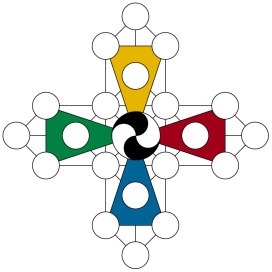
When dividing the year into 4 quarters, we get 91 days to work with. This is 13 weeks (as well as 7 x 13-day week). Nice and even. However, 91 has another special numerical property: it is the sum of 13 + 12 + 11 + 10 + 9 + 8 + 7 + 6 + 5 + 4 + 3 + 2 + 1. What can we do with this?

In the image above, the Solstices occur at the very bottom and very top, the Equinoxes at the sides. While we are in the dark days of Winter, or the light days of Summer, the rate of change of daylight from day to day is quite slow. At the Solstices, the change from day to day might be 1 second, if there is any noticeable change at all. At the Equinoxes, the change is at its height, which varies depending on the line of latitude at which you live. Around 45 degrees, the change is a little over 3 minutes per day.
This creates a cycle of acceleration throughout the Year. At the Norther Winter Solstice, the days are at a standstill. Everything is equally dark (about 16 hours at 45 degrees). As we move through the year, each day becomes slightly longer, at first by a second, then a couple, then more and more until we reach the peak point around the Equinox.
This is the place for the variable weekdays.

If you begin at theAbysmal New Year (december 21st) at the bottom, and follow the quarters clockwise. Rows at the bottom are read right to left, rows at the top are read left to right.
Elevensies
As far as I’m aware, this is a novel and unique calendar system. The 13-month system divides the year into 364 days plus 1 day. Several calendar systems divide the year into 360 days plus 5 days (theAbysmal also does this). The Bahá’í calendar divides the year into 361 days plus 4 days (that’s 19 periods of 19 days plus 4).
theAbysmal divides the year into 363 days plus 2. This creates a year of 11 months of 33 days, which are organized by 11-day week. I’m currently referring to this as the “elevensies” calendar, which happens to be the glyph number for Raccoon. The trickster runs this show.
This is an ongoing experiment, so there is nothing definitive about these particular iterations. I have set the New Year at June 23rd (the beginning of the second semester), also at August 6th (the day 1~Raccoon occurred at this date this year). This calendar does not include a leap year day, and I’m yet undecided if the 2 extra days are included as leap days, or whether the 363 days of the year are continuous and unbroken, or maybe just 1 extra day is included.
The point of this experiment is to see if the rather orderly structures of theAbysmal calendar can be subverted with some kind of disruptive daykeeping. So far, patterns emerge regardless. I am of the opinion that the Elevensies calendar of the Raccoon will be adjusted every year such that it will be a chaotic mess within a few seasons.
For the now, here are the versions begun theAbysmal Year 6, 7~Night (dec 21 2019-dec 20 2020)
Year 1~Raccoon, 11-day weeks, 11 months
Year 7~Deer, 11-day weeks, 11 months
Year 7~Deer, 11-day weeks, 11 months, Red Shift (black/white/red)

evoking the Trickster – this should go well…


 Rethinking Time